This past week may have been the most consistently satisfying week of cinema-going since I started this journey with you back in 2006: seven very different films, all with something to offer. And no turkeys this week, so I’ll have to put the acid away until next week.
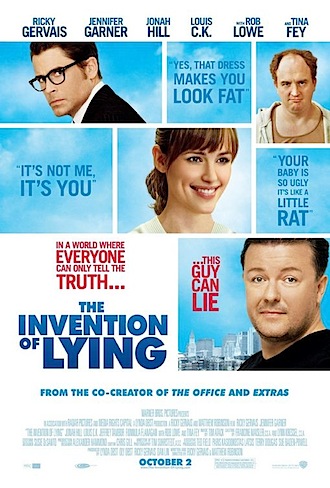
 In completely arbitrary order (of viewing in fact), let’s take a look at them. In The Invention of Lying British comic Ricky Gervais directs his first big screen film (working without the creative support of usual partner Stephen Merchant) and it turns out to be a little bit more ambitious than most Hollywood rom-coms. In a world where no one has any conception of “untruth”, where the entire population makes each other miserable by saying exactly how they feel all the time and where there is no storytelling or fiction to give people an escape, Gervais’ character discovers he has the ability to say things that aren’t true and is treated as a Messiah-figure as a result. Everything he says, no matter how outlandish, is believed but he still can’t win the love of the beautiful Jennifer Garner.
Gervais is solidly funny throughout, and demonstrates even more of the depth as an actor that he hinted at in Ghost Town last year, but the direction is uneven – perhaps because both Gervais and co-writer-director Matthew Robinson are first-timers.
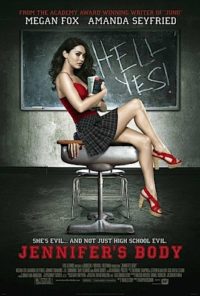 Your enjoyment of teen horror flick Jennifer’s Body will be dictated by several factors: your tolerance for the self-consciously whimsical dialogue from screenwriter Diablo Cody (Juno), your tolerance for Transformers star Megan Fox and the way she wears (or doesn’t wear) her clothes and your tolerance for humour at the expense of whiny indie rock bands. I can handle all three so had a perfectly good time.
The lesson here is that if you are born in a town with the word “Devil’s” in the name, get out as soon as you can.
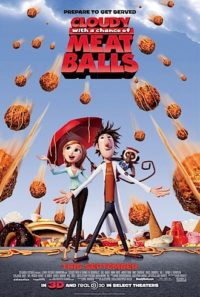 Cloudy With a Chance of Meatballs is an inventive and amusing animated family adventure that did a good job of keeping me entertained along with all the youngsters on Saturday morning. Flint Lockwood (Bill Hader) is a young inventor in a small, depressed town. Despite being the butt of everyone’s anti-nerd jokes, he persists until his water-into-food machine looks like it will save the town from ruin. Of course, like every invention that seems too good to be true this one goes haywire, and Flint, along with meteorologist love interest Sam Sparks (Anna Faris) and town mascot “Baby” Brent (Andy Samberg) has to save the day.
One of the strengths of Meatballs is the voice casting, particularly Mr T as the cop with a heart of gold and Hollywood legend James Caan as Flint’s dad, Tim. His tortuous fishing metaphors are very amusing but when it comes to sardines and trawler imagery no one tops the great Eric Cantona (“When the seagulls follow the trawler, it’s because they think sardines will be thrown into the sea. Thank you very much.”) who gets his own starring role in Ken Loach’s new film Looking for Eric. Now, I’ve always been more of a Di Canio kind of bloke than a Cantona fan but his presence in this film is very appealing, even though he isn’t the Eric that the film is looking for.
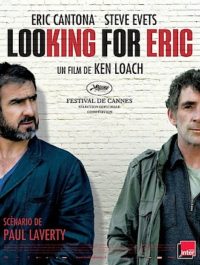 The actual Eric is a depressed Manchester postie played by TV veteran but cinema newcomer Steve Evets. Unable to connect with his stepchildren, his ex-wife and his mates at the post office, Eric conjures up an imaginary friend in the shape of the talismanic United midfielder who proceeds to give him opaque and elliptical life coaching, often in French.
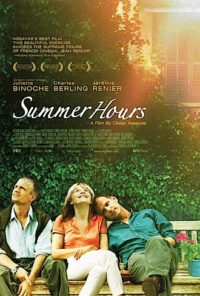 I finally got to see Olivier Assayas’ thoughtful family drama Summer Hours on Sunday morning (a week after it opened) and I’m very glad I did. On the passing of the family matriarch (Edith Scob), three siblings (and) have to decide what to do with the beautiful rambling country house and all its contents. The oldest, Frédéric (Charles Berling) has the happiest memories of the place and wants to keep it intact while the others (Juliette Binoche and Jérémie Renier) would rather it was sold so they can invest in their own lives.
That’s pretty much the extent of the drama and it is deftly underplayed by Assayas and his cast and some delightfully ironic moments are allowed to just hang there in the breeze. Highly recommended.
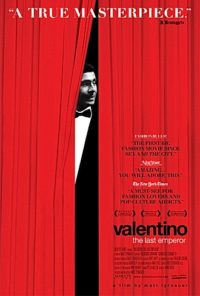 Another film about generational transition and a changing world came along just after lunch: Valentino – The Last Emperor, in which the last of the great iconic couturiers is forced to contemplate the end of a glamorous époque when confronted by global mega-business, hedge funds and “Chief Design Directors” rather than “Maestros”.
The relationship between Valentino and his long-time partner, lover and business associate Giancarlo Giammetti is very moving and his focus on his work, his mission, reminded me of a few other documentaries this year in which public caricatures are revealed to be serious, real people: This is It and The September Issue specifically. It’s a shame that it wasn’t shot on film or hi-def as the quality of the dressmaking crafts-person-ship is only rarely allowed to shine.
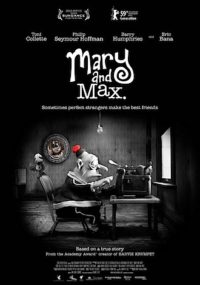 Finally, I might have enjoyed the odd Mary and Max a bit more without the sound problems and restless audience members kicking me in the back. Even then I found the immaturity of the writing (lots of toilet humour) was only just compensated for by some, I think, genuine heart and love for the characters. An Australian stop-motion animated film, Mary and Max is about an unlikely pen-pal relationship between 8‑year-old Mary from Melbourne (Toni Colette when she grows up) and a 44-year-old Aspie in New York named Max (Philip Seymour Hoffman). Their relationship deepens and grows (and fractures) over the years and the ending is genuinely moving but I couldn’t quite get to grips with the sudden changes of tone.
Printed in Wellington’s Capital Times on Wednesday 2 December, 2009.
Notes on screening conditions: I alluded to sound problems in Mary and Max: major digital soundtrack drop-outs through all but the final reel (Paramount Bergman). Summer Hours played like the used Festival print that it was (Lighthouse). Looking for Eric was a passable digital presentation at the Lighthouse. Jennifer’s Body looked good in the Brooks (the smallest) cinema at the Paramount) and The Invention of Lying was washed out (the source material) at Readings.