Freud’s Last Session and The Garfield Movie are in cinemas, Great Photo, Lovely Life is streaming on Neon and Atlas is on Netflix
Apologies, once again this Friday new releases edition of the newsletter is late.
In mitigation, I did spend 90 minutes this morning interviewing the guy who designed the Battletruck in 1982 and much of the rest of the time has been spent responding to birthday greetings.
As a reminder, next Monday is a public holiday in Aotearoa/New Zealand so there will be no daily recommendation. Normal service will resume on Tuesday.

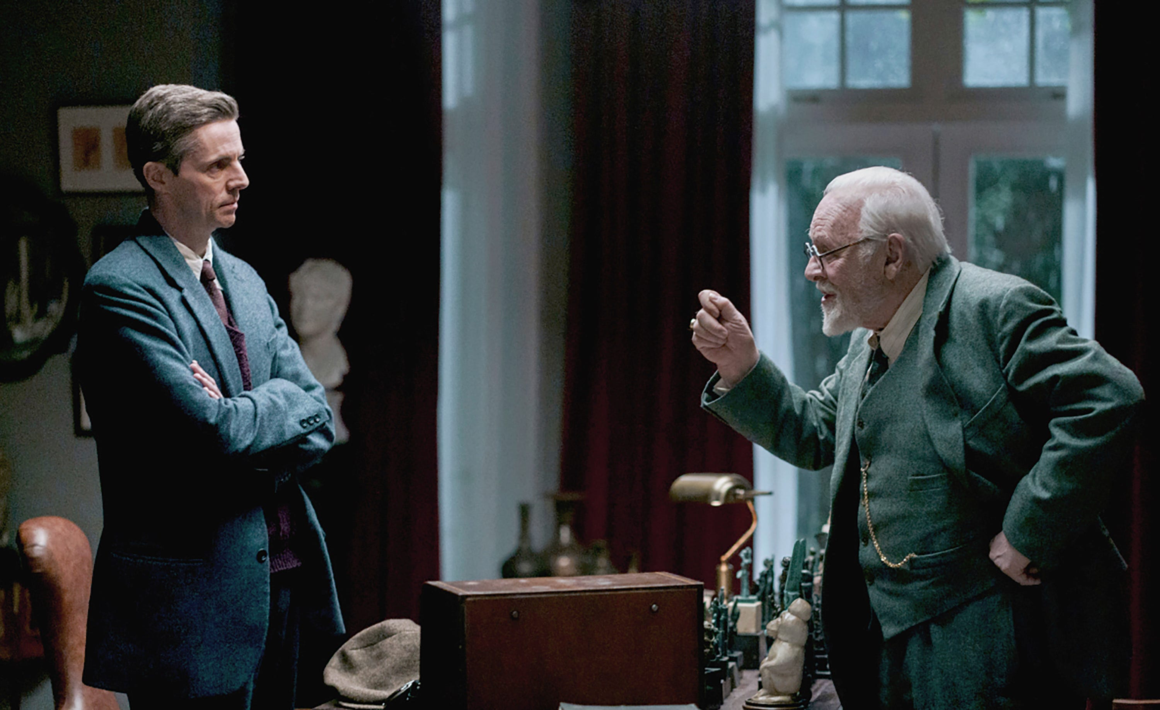
Freud’s Last Session started life as a popular stage play and Matt Brown’s adaptation (with the script collaboration of playwright Mark St. Germain) often feels bound by those constraints.
Don’t get me wrong, two people talking in a room for 90 minutes can be riveting – on stage or screen – but only if the conversation goes somewhere.
Sigmund Freud, father of psychoanalysis and one of the great rational minds of the 20th century, is marooned in North London after escaping the Nazi occupation of his beloved Vienna. On the day that World War II breaks out, he conjures a meeting with an Oxford professor who has written a book promoting Christianity.
Freud is one of the loudest atheists in the world – several times in the film he describes religion as “childish superstition” – but he is dying of cancer, Hitler wants his race to be exterminated, his daughter is in a relationship he doesn’t approve of and his beloved dog can smell the tumour and doesn’t want to be near him.
He’s clearly always been fascinated by religion – his ‘den’ is full of relics and artefacts – but he has always thought of it as an example of our subconscious needs conjuring conscious thoughts. But in this time of existential crisis, is there something more?
Or does he just want to spar with someone?
The fictional conceit of the film is that the Oxford don concerned is the great literary Christian, C.S. Lewis, who is about to embark on the series of wartime lectures on faith that would make his name, before publishing a famous series of children’s books about a land called Narnia.
I wish the debate between them had been more interesting but it devolves too often into the kind of arguments I was having with my born again friends at high school. How can a loving God create a world that has such suffering in it? How does one explain creation itself, if not at the hands of a creator?
There are moments when each character shows that their position isn’t absolute – some doubt is shared equally between them – but thanks to ego, those doubts go mostly unacknowledged.
Where the film gets much more interesting is the relationship between Freud (Anthony Hopkins) and his daughter Anna (Liv Lisa Fries). Psychoanalysed by her father when she was younger – surely an ethically ill-advised move – he refuses to accept her sexuality and allow her lover (Jodi Balfour) to join them in the house. Only male homosexuality is explicable in his psychoanalytical worldview.
Hopkins remains a remarkable screen presence at the age of 86 but this isn’t one of his best recent performances – there’s a little giggle that he does to punctuate a speech and it feels too familiar, too much like ‘business’. Goode, though, knows enough to hold his own by not trying to compete.
I heard Brown, the director, interviewed by Susie Ferguson on RNZ the other day and he asserted that the film does not take sides in the debate between Christianity and atheism and that he wanted audiences to be able to make up their minds.
That would be fair enough if a compelling case for either was actually made but it doesn’t quite get there. What it does do, is show us two men staring into the abyss of death – Freud because of age and Lewis haunted by the trauma of World War One – and knowing that they have to face it alone.

While many you were wailing and rending your garments during the New Zealand governments’ annual budget announcement, I was avoiding it by watching the latest reboot of the Garfield franchise and, on reflection, I feel like you got the better of that particular deal.
The Garfield Movie (not to be confused with Garfield: The Movie from 20 years ago) feels exhausted from the very beginning. The script is tired, the animation is derivative and why would you pick Chris Pratt as a character voice when no one would be able to pick it out of a police lineup?
The content below was originally paywalled.
It feels like every production decision is simply the first thing that somebody thought of. I’m as big a fan of Ted Lasso as the next man but was it zeitgeisty enough to be raided for two cast members? With an Apple Christmas special, a starring role in The Fall Guy and now a featured voice in Garfield, surely Hannah Waddingham was the big winner out of that show.
Even Samuel L. Jackson as Garfield’s long lost father, Vic, feels like he’s phoning it in and that never happens.

Great Photo, Lovely Life is one of the most confronting and distressing documentaries I have ever seen. The title comes from the handwritten description on a family photo discovered by filmmaker Amanda Mustard as she goes through the boxes of pictures, home movies and videos recording her Pennsylvania family over nearly sixty years.
Of course, it wasn’t either of those things. Mustard is on a quest to try and understand how it could be that her popular grandfather, Bill Flickinger, could get away with sexually abusing dozens of young girls – including members of his own family – for decades.
The film opens with Mustard and her mother Debi, visiting Bill in his rest home in Florida. They ask him about what happened and, frankly (you think), he tells them. But there’s instantly something self-serving about his account. I wish I’d gotten help, I’m so much better now, and then the gut punch, They wanted it. Girls as young as nine.
As Mustard’s investigation goes on she reaches out to hundreds of Bill’s chiropractic clients and gets responses from so many grown women with stories to tell from their childhoods. Only a couple are prepared to talk on camera but their testimony is devastating.
But it’s the role of the family in these crimes that is so hard for Mustard to take – and for us to watch. Her grandmother’s Christian requirement to ‘stand by her man’ even to the extent that she turns a blind eye to the abuse of her own granddaughter is inexplicable but, I suppose, all too common.
The number of people in this film who insist that victims need to forgive their betrayer because “that’s what God asks” is dispiriting in more ways than one. It’s God that Bill relies on to apportion judgement for his crimes. He doesn’t believe that he should be punished in this life because the worst is yet to come, but that’s no comfort to his victims.
Like a great horror film, Great Photo, Lovely Life shows us that sometimes the monster is already in the house.

Sometimes I think the mission of these Friday updates – which is to survey the biggest and most prominent new releases in theatres and online – has been fatally compromised by how crappy most streaming blockbusters are. I watched the $100m sci-fi Jennifer Lopez vehicle Atlas this morning and I really don’t want to have to do that anymore. Happy birthday to me, indeed.
I’m glad that there are so many people being employed and everything, but these films (e.g. Rebel Moon, The Tomorrow War, The Gray Man, etc.) are sapping whatever joy I have left in this business. And, like Sigmund Freud in Freud’s Last Session, I am realising that life is too short.