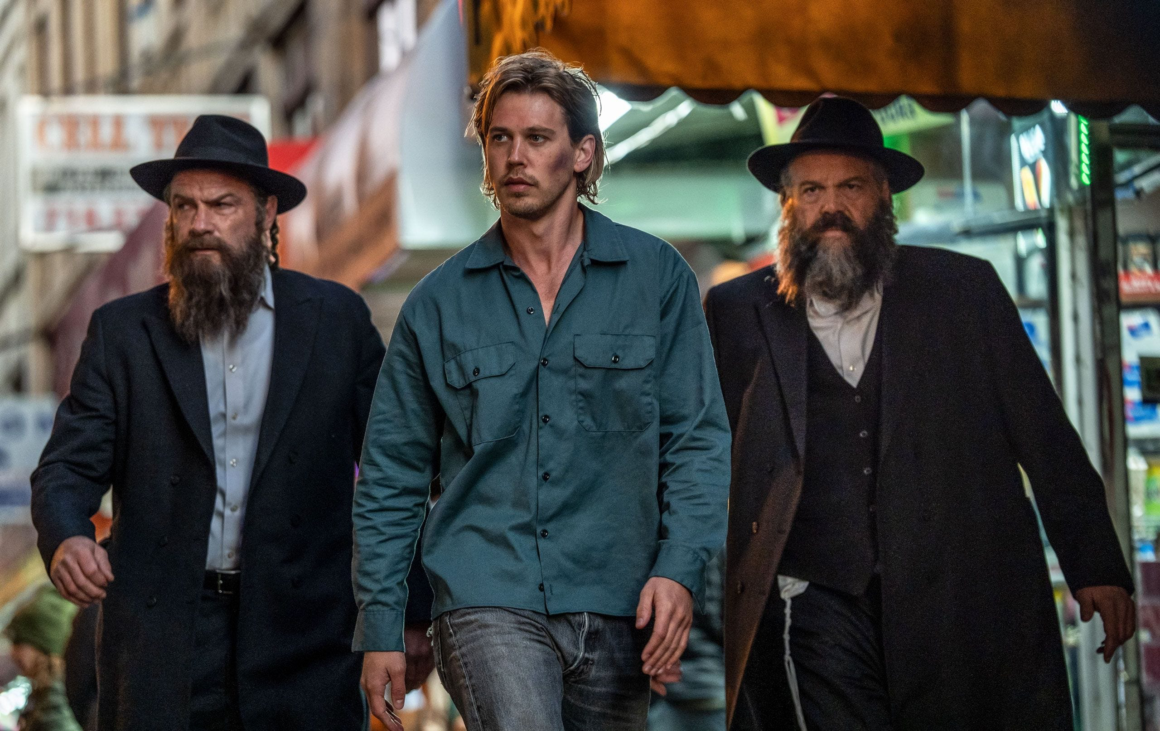
People often (sometimes … occasionally) ask me when we are talking about a film, “What’s it about?” In the case of Darren Aronofsky’s Caught Stealing, the immediate answer would be: it’s about Hank (Austin Butler), a former baseball contender turned New York barman and alcoholic who is dragged in to a mob war over missing drug money when his neighbour asks him to look after his cat for a few days.
Then they sometimes (occasionally … actually never) say to me, “No, what’s it really about?” That’s a question I ask myself, because it’s the job of a critic to think about these things, but when I turned my attention to the “what it’s really about” of Caught Stealing, I came up empty handed.
Is it about nostalgia for a pre‑9/11 New York, full of friendly dive bars, salt-of-the-earth vagrants and skody-but-affordable apartments? Maybe, a little. Is it about trying to live up to a moral code in a ruthless world? Not really, even though two of the most monstrous villains are Orthodox Jews (Liev Schrieber and Vincent D’Onofrio) who worry about correctly observing Shabbat while carrying semi-automatic weapons and grenades.
Is it about how the only reliable relationship a young man has is with his mother? Or his cat? Or is that eventually you have get over yourself and grow up (except that Hank’s eventual emotional growth appears to be unconnected with the excessive trauma he is put through)?. And, trust me, it is excessive. I’m not sure why the violence should be so extreme, but Aronofsky is unable to prevent ‘fun’ action — that would be more in line with the whacky characters and attempted banter — from turning into sheer nastiness.
Caught Stealing is also about baseball — a wasted talent for it and an obsessive fandom for it — which might also not mean much to audiences who don’t appreciate America’s pastime.
It might sound as if I am a hypocrite regarding screen violence – sometimes it works and sometimes it doesn’t — but I can get behind it if there’s some kind of moral compass at work, which is the case in Macon Blair’s reboot of the legendary Troma B‑movie antihero story, The Toxic Avenger. Besides, the gore in a film like this is just like custard pies for grown-ups — ridiculous slapstick — and if the timing of the editing works alongside the sound effects then a good time can safely be had by all.
The silliness is the point — Blair’s script is very witty — but The Toxic Avenger is also a better version of a “state of modern America” picture than Aster’s Eddington last week. Peter Dinklage plays doting stepfather to Jacob Tremblay’s sensitive teenage orphan, living in a New Jersey town (called St. Roma) dominated by a factory that spews out unregulated toxic waste while making utterly ineffectual wellness products.
Dinklage is a janitor at the factory and prolonged exposure to all that waste means he’s growing tumours throughout his brain. Health insurance proving to be useless, he tries to steal some cash from the vault but the robbery goes wrong and he — and his mop — are dumped into the green goo from which he emerges the next day as a repulsive monster with super powers and a still-decent heart.
If you needed any confirmation that this Toxic Avenger is on the right side of history, note the presence of two Ted Lasso alumni in the cast. That would make for an interesting crossover. Final lesson is that when you really want to find some quality post-industrial wasteland locations, you need to go to Eastern Europe — Bulgaria in this case.
How to Make a Killing (returning from the recent French Film Festival) has some violent moments but these are also played for comedy:
An even darker comedy is on offer in Franck Dubosc’s How to Make a Killing (aka Un ours dans le jura – A Bear in the Jura, I can understand why the literal translation here wasn’t used …). Dubosc himself plays Michel, a struggling pine tree farmer on the verge of the Christmas rush, is startled by an unlikely bear on the road and crashes his ute into a rich-looking couple who have stopped by the side of the road for a pee. These are not your average rich-looking couple, however, as they are intermediaries between some hardened gangsters and migrant drug mules in the forest. The 2 million Euros in their car then becomes a source of some temptation – not just for Michel and his wife (Laure Calamy) but for everyone in the village who comes into contact with it.
Played with admirable deadpan by everyone – not least the outgunned town cop, Benoît Poelvoorde – this is another crowd-pleaser with some neat plot twists. It also manages to patronise the poor migrants who are given not-a-jot of their own humanity to share with the audience.
Returning (in some regions) from the New Zealand International Film Festival is David Cronenberg’s The Shrouds:
The Shrouds might be David Cronenberg’s most overtly personal film in an almost 60-year career. It contains many of his visual trademarks – the body horror moments are less plentiful but just as shocking when they arrive. Cronenberg avatar Vincent Cassel plays a grieving husband (Cronenberg lost his wife, Carolyn Zeifman, in 2017) who invents a kind of 3D scanning wrapper that can present an image of your deceased loved ones decaying body onto a headstone screen or, if you prefer, you can monitor it remotely using an app.
He’s a tech CEO now, planning a global expansion of these digitally enhanced burial grounds, but he’s also haunted by images of his late wife (Diane Kruger who also plays her twin sister) and the terrible deterioration as cancer spread throughout her body.
While grief is both text and subtext in The Shrouds, Cronenberg also gives us a modern thriller including both conspiracy theories and actual conspiracies, as well as satire about Chinese industrial espionage, digital surveillance, self-driving cars and AI assistants who can present themselves as wombats to make themselves less creepy.
Ultimately, The Shrouds is about what happens to someone when they can’t keep a promise to the dead …
Finally, I’ve mentioned regularly here that star-studded streaming titles have been a consistent Saturday night disappointment and I’m sorry to report that we have a new champion.
Both the editor-in-chief and I fell asleep during Chris Columbus’ adaptation of the publishing phenomenon that is The Thursday Murder Club. Everything about it is lazy, not least Pierce Brosnan’s attempt at a cockney accent. I can see the potential of the concept — a group of true crime-obsessed pensioners solve a murder much closer to their retirement home — but we already have Only Murders in the Building, thanks, and execution is everything. You can’t just throw these people together in a rest home that looks like Downton Abbey and assume everything will work out.
You have to write a script, direct the actors, have a point of view. Our Saturday nights in front of the telly from now on, are now going to be devoted to proven quality which means — probably — something much older. As I like to say, there are more good old films than there are good new films and the streamers are proving me right, week in and week out.