New Zealand documentary making was well represented either side of Waitangi Day by The Haka Party Incident and Alien Weaponry: Kua Kupu Te Ara.
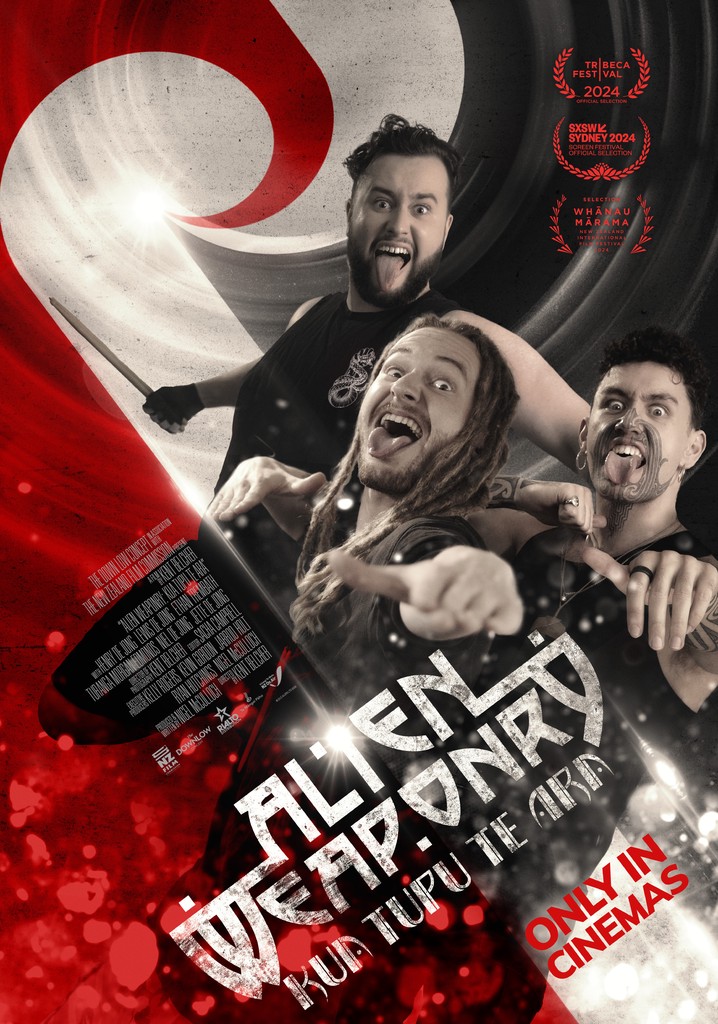
There are two main ways a doco can distinguish itself – a great story or great access, and Kent Belcher’s film about the young metal band Alien Weaponry has both. Three teenagers from small town Northland, New Zealand, become stars of the globally competitive heavy metal scene by shredding brilliantly and bringing their own culture to the party – adding not imitating.
Brothers Henry (drums) and Lewis De Jong (guitar), along with former bass players Ethan and Wyatt, got their early breaks on the cultural phenomenon that is Smokefree Rockquest and were already touring the festivals of Europe and North America by the time they were 18 and 16 respectively. Traveling with their dedicated parents, Niel and Jette, they were also followed on that first big 2018 trip by Belcher’s camera.
He’s been around the band for six or so years which brings a remarkable intimacy to a documentary that might easily have had the edges polished off by a careful record company. Instead, we see relationships frazzle, temptations being succumbed to, and – in a heartbreaking sequence – one brother’s youthful exuberance threaten years of work.
If you are not a big fan of the genre, don’t worry because there’s not enough of the music to put you off – just enough to give you an idea of what the passionate blend of thrashing guitars and Māori waiata can be like. The metal community looks scary from the outside but we also see how much aroha is generated by these boys and their uniquely committed vision.
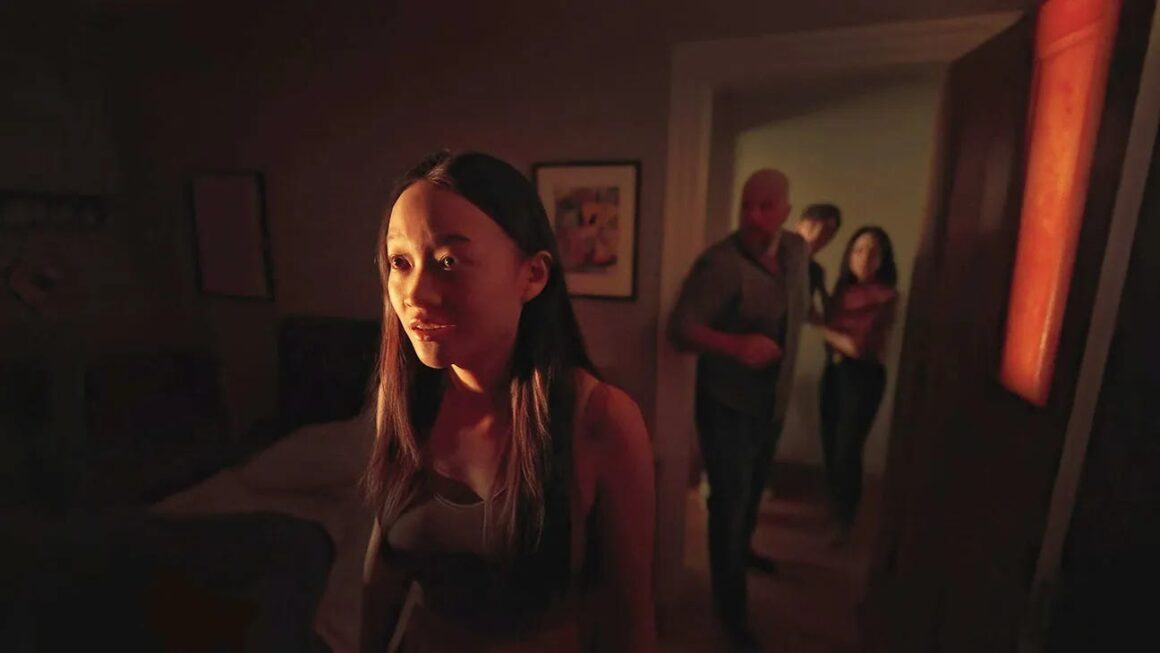
There’s a Swedish film called The Five Obstructions in which, avant-garde filmmaker Jørgen Leth is challenged by Lars von Trier to remake his 1960s short film The Perfect Human several times with an increasingly bizarre set of constraints. I wonder whether Steven Soderbergh is doing the same thing to himself during this period of his career. As if he’s finding that filmmaking comes to him so easily he has to choose restrictions in order to keep things interesting. Make a big budget HBO drama series 10-months after “retiring” (The Knick), release a film as a mobile phone app (Mosaic), shoot with only an iPhone (Unsane), shoot during a two-week transatlantic sea voyage (Let Them All Talk), shoot a Hitchcockian thriller at the height of a pandemic (Kimi), make a science-fiction series to be released for free on the web (Command‑Z).
With Presence, Soderbergh hasn’t chosen a production difficulty, more of a challenging storytelling device. The film is a ghost story told entirely from the point of view of the ghost – a first-person viewpoint from something that may not even be a someone.
A family of four buys a big old house and settles in but, despite the happy outward appearances, everyone has their troubles. Mum Rebecca (Lucy Liu) is a successful executive but may have made some unwise choices that threaten the family with legal jeopardy. Son Ryan (Eddy Maday) is an ambitious swim champ with a judgemental streak. Daughter Chloe (Callina Liang) is grieving the sudden death of a close friend. Dad Chris (Chris Sullivan) is struggling to keep the family together – the film is called Presence after the entity that they share the house with but it could just as well be about the lack of presence that they have in each other’s lives.
One could quibble about the logic a little bit – this poltergeist hovers with a steadicam-like point-of-view but still uses the stairs rather than float over the bannisters – but using the device to eavesdrop on different family members (and their guests) and occasionally intervene is quite a neat way to parcel out information.
There are a couple of jumpy moments but this is a haunted house film rather than a gory horror – unlike the trailers that played beforehand for films that I am really not looking forward to.
September 5 is a history lesson set around the 1972 Munich Olympics terrorist tragedy in which Palestinian freedom fighters took advantage of global visibility to take several members of the Israeli team hostage. The story isn’t particularly interested in their cause, however, but does take an interest in the irony that these Jewish athletes were attacked on German soil, reminding everyone of a history that they were trying to forget.
The content below was originally paywalled.
The main topic, though, is the media and the invention – under the worst circumstances – of rolling, perpetual, news coverage. ABC TV had the North American broadcast rights to the games, the first time that the event could be transmitted live around the globe thanks to satellites. When hostages are taken in the Olympic Village, the production team soon realises that they are the best placed to tell the story as it happens – except that they are sports broadcasters, not news journalists.
We still have rolling news on 24-hour cable channels but now many us are kept informed by scrolling news instead and most of the audience won’t realise from this 50-year distance how nobody knew what they were doing in those days. And many won’t know how the story ended, either.
September 5 is a tense production directed by Swiss Tim Fehlbaum and almost every moment happens inside the crowded studio that is the nerve centre of the ABC operation – it’s a submarine movie. Peter Sarsgaard plays real-life tv producer Roone Arledge and John Magaro (First Cow) is the young director flying by the seat of his pants. Leonie Benesch from The Teacher’s Lounge plays a production assistant who becomes crucial to the operation when they realise she’s the only one there who speaks German. MVP though is the real-life archive footage of anchor Jim McKay who, despite his sports background, channels his inner-Cronkite to communicate the inexplicable gravity of what is going down.
Most of the actors in September 5 are American but behind the camera is almost one hundred percent European – the film was actually produced in Bavaria which is a unusual gesture towards verisimilitude considering it’s almost all shot on a soundstage.
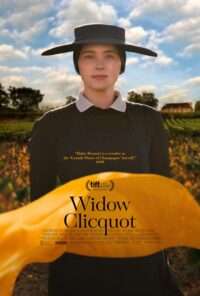
The same is true of Widow Clicquot – everyone on the crew is French and the locations are the vineyards and chateaux of French wine country but the faces and voices are almost all British. It’s the story of the invention of what we now know as champagne – although that doesn’t become clear until the end – by Barbe-Nicole Ponsardin Clicquot during the disruptions of Napoleonic France in the early 1800s.
American actress Haley Bennett plays Barbe, from an established wine family and married to François Clicquot (Tom Sturridge) as a way to secure the interests of both families. François was innovative but unreliable and when he dies suddenly Barbe – a visionary in her own right – chooses to keep the business rather than sell.
Her only ally is Sam Riley as the charming wine merchant Louis Buhne and, while she works on the science of sparkling wine, he attempts to break Napoleon’s embargo. A handsome film with a structure that cleverly keeps the reality of François’ deterioration discrete until the audience can’t do without it. Produced by Joe Wright (Atonement, Pride & Prejudice) and directed by his long-time second-unit director Thomas Napper (on Anna Karenina the second unit was actually called the Napper unit), Haley Bennet is also Mrs. Joe Wright so it’s a bit of a family affair all round.
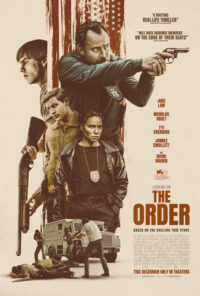
I only had time for one of the two new feature films on Prime Video this week. The Order is based on the true story of a 1980s FBI investigation into white supremacist terrorists. At the beginning, a Jewish talkback host played by Marc Maron makes the claim that anti-semites and racists like the boorish bullies who call him will never be successful because they simply don’t have the talent or organisational skill to pull off overthrowing the government – a bold claim to be made at a time when they appear to have done just that in real-life.
Jude Law and his prodigious moustache plays the broken FBI agent determined to bring these redneck yeehaws to justice and Nicholas Hoult is the young bigot who wants to start a race war. There’s some interesting stuff in here about how this delusional militia are motivated by perceived economic disadvantage – the Trumpian argument that we have been hearing for so long – but this is really a cops and robbers movie and the best thing in it is Jurnee Smollett as Law’s black FBI agent partner, the only person in the film with skin, shall we say, in the actual game.
I’ve harped on a bit in today’s column a bout where things get made as opposed where they look like they’ve been made but I do want to finish by noticing that in The Order, the wide open spaces of Colorado, Missouri, Washington and California are all played by Alberta, Canada, and the post-production is all done in director Justin Kurzel’s home country of Australia. This might explain why a rundown bar in Idaho in 1983 would be playing Dragon’s antipodean smash hit “Rain” so loudly.