Preview: Intrepid French Film Festival Aotearoa 2025
While the Italians make their slow-but-steady way around the country for 11 months, the French Film Festival packs all its activity into four weeks from today – at 35 cinemas in 21 centres. There are 23 feature titles in the programme and, unlike the Italians who like to go back to the classics, these are all brand new.
I only got to preview three of the 23 so I won’t pretend that they are in any way representative, in fact they feel suitably random.
This week I finally read Robert Bresson’s famous 1975 manifesto Notes on the Cinematographer. I’ve had my pre-loved copy for at least ten years and this edition was published in 1986 (and is helpfully annotated by the previous owner).
Bresson’s definition of cinematographer isn’t the camera or lighting director as we understand it now. He was making a distinction between cinema (defined by him as filmed theatre with all of the inauthenticity that entails) and cinematography – an essential and unmanipulated filmed truth. Bresson doesn’t argue that there’s anything wrong with theatre per se, just that attempting to recreate the artifice of theatre with a camera is the wrong approach:
The photographed theatre or CINEMA requires a metteur-en-scène or director to make some actors perform a play and to photograph these actors performing the play; afterwards he lines up the images. Bastard theatre lacking what makes theatre: material presence of living actors, direct action of the audience on the actors.
He is scathing of acting for camera and he describes the talent he photographs as “models” rather than “actors”:
In a mixture of true and false, the true brings out the false, the false hinders belief in the true. An actor simulating fear of shipwreck on the deck of a real ship battered by a real storm – we believe in neither the actor, nor in the ship nor in the storm.
I think Tom Cruise might have something to say about that.
Bresson was losing this argument even as he was writing these notes in the 1950s and definitive proof of that loss can be found in the three films I preview here. Yet, I couldn’t help feeling as I was watching them that truth – Bressonian truth, human truth, emotional truth – was never what these films were interested in and that maybe, thanks to Bresson, I was seeing feelings being manufactured in front of me more than usual.
The programme launch film Les règles de l’art has the terrible English title, The French Job to kindle memories of Michael Caine’s 60s heist film The Italian Job, a comparison that does neither film any favours. Based on an unlikely true story, it’s about a burglary at the Paris Museum of Modern Art and the attempts by the thieves to successfully fence some of the most famous paintings in the world. Actually, nobody knows for sure what happened to them and Dominique Baumard’s film is a fanciful and entertaining imagining of the whole affair.
The content below was originally paywalled.
Melvil Poupaud plays a mild-mannered insurance assessor and watch valuer drawn into the orbit of conman Sofiane Zermani and burglar Steve Tientcheu. The “law-abiding” one of the trio being played by a white actor while the genuine criminals are of Algerian and Camerounian backgrounds felt like a tone-deaf choice to me, but the performances by all three got me past it.
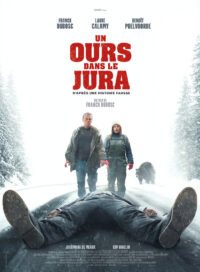
An even darker comedy is on offer in Franck Dubosc’s How to Make a Killing (aka Un ours dans le jura – A Bear in the Jura, I can understand why the literal translation here wasn’t used …). Dubosc himself plays Michel, a struggling pine tree farmer on the verge of the Christmas rush, is startled by an unlikely bear on the road and crashes his ute into a rich-looking couple who have stopped by the side of the road for a pee. These are not your average rich-looking couple, however, as they are intermediaries between some hardened gangsters and migrant drug mules in the forest. The 2 million Euros in their car then becomes a source of some temptation – not just for Michel and his wife (Laure Calamy) but for everyone in the village who comes into contact with it.
Played with admirable deadpan by everyone – not least the outgunned town cop, Benoît Poelvoorde – this is another crowd-pleaser with some neat plot twists. It also manages to patronise the poor migrants who are given not-a-jot of their own humanity to share with the audience.
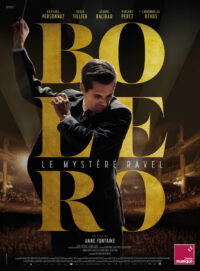
Much more frustrating to try and follow is the musical biopic Bolero, about the creation of the famous piece of music by early 20th century composer Maurice Ravel (Raphaël Personnaz). The opening titles make innovative use of the piece’s ubiquity since its debut in 1929 but you may end up becoming as sick of it as the actual Ravel was before the film ends. Bolero is only 17 minutes long and I feel sure we heard the whole thing multiple times, despite Ravel himself suggesting that the piece “contained no music”.
The long sections of the film devoted to Ravel scratching out notes – either in his study at the piano or in his (real-life) garden, only confirmed to me what I’ve always thought about composing music. That the composer simply finds a note that they like and then tries every other note – one after the other – until they find one that goes with it, and so on and so forth.
By focusing on the period during the composition of Bolero for a ballet by Russian emigré Ida Rubinstein (Jeanne Balibar), the film actually leaves out – or simply alludes to – lots of other interesting aspects of Ravel’s life. Interesting aspects, but perhaps not dramatic enough for a whole film. Anyway, Bolero was a disappointment and I found myself wishing that I’d chosen the other music-themed film, Monsieur Aznavour.
Also not previewed, but catching my eye nonetheless, an epic new version of The Count of Monte Cristo and the mid-life crisis comedy This Life of Mine, a film made poignant by the passing of writer-director Sophie Fillières before she could complete it in 2023.