Momentum is an underrated commodity. After taking a few days off last week to painstakingly rebuild some critical workflows (in order to preserve the value of decades of muscle memory) I now find myself having to get this caravan moving again from a standing start.
Here’s a summary of what I’ve seen at the cinema recently to get the typing fingers moving again. I’ve yet to catch up with Splitsville or three of the school holiday releases: Dora: Magic Mermaid Adventures, Gabby’s Dollhouse: The Movie or Kangaroo.
Reader RI of Auckland emailed to say that The Long Walk was a favourite Stephen King story of his and he was curious to hear what I thought. Rich — I expect you’ve seen the film for yourself by now but here goes.
It’s one of those classic King “What if” stories, a deceptively simple premise but one that gives him — and his adaptors, director Francis Lawrence and screenwriter JT Mollner — plenty of room to test its boundaries. What if, in an alternative post-some kind of conflict United States, a young man is chosen to represent each of the 50 states in an athletic contest that would provide a spectacle to unite a recovering nation. What if, indeed? We’ve seen versions of this before. King’s The Running Man (soon to be rebooted with Glen Powell), The Hunger Games franchise (which Lawrence himself looked after for all but the first film) and the recent John Cena/Awkwafina vehicle Jackpot! which played the concept for laughs.
Of course, this is a dystopic scenario and the Long Walk contest is a vehicle for reinforcing fascist control. One young man will win a fortune and the granting of a wish but the other 49 will lose their lives — pour encourager les autres.
Each contestant is chosen by lottery, supposedly, but entering the lottery does not appear to be voluntary and the selection appears to be loaded by the organisers, in the shape of “The Major”, played by Mark Hamill in his second King-related role this year.
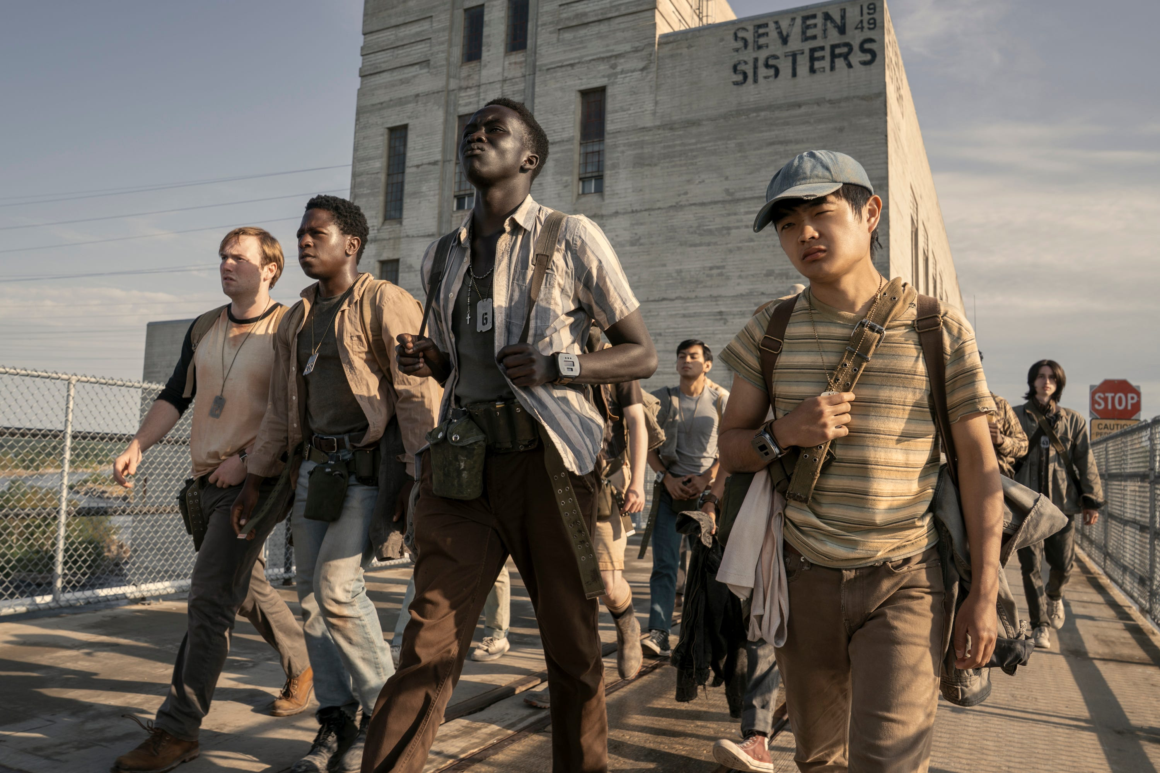
The walk is non-stop — not for sleep, food or even calls of nature. Hour after hour, mile after mile, these young men walk and, while they make something akin to friendships, they all know that the odds are stacked against them and no alliances will survive to the end of the contest.
While all of the characters are well-drawn, our focus is on Cooper Hoffman as Ray — the only character whose backstory we see — and David Jonsson as Peter. Even thought they form a bond, their motives are very different, because their stories are very different. One is on a mission of revenge because of what the régime has caused him to lose. The other started life with nothing and therefore sees the walk as a way to do some good for others, provided he can actually win it.
Uncommented on — but clearly important to the central metaphor of the thing — is the absence of women to the scenario, except Judy Greer as Ray’s mother. Seeing him off with a sandwich at the start, helplessly witnessing his deterioration from the sideline.
The Long Walk is about as bleak a story as I’ve seen in years. Lawrence eschews the high camp of the Hunger Games’ Panem for an arid mid-western semi-rural wasteland. You can feel the poverty, of hope as much as anything material. The sudden bursts of violence are shocking and gruesome. I thought for a while that they were too much — we get the point — but there’s nothing gratuitous about the violence and the visuals are just as awful as the psychological and emotional torture these boys are put through.
A thoughtful and sobering watch.
Downton Abbey: The Grand Finale was my first exposure to a franchise that I could have sworn had been around for decades I’m was assured by the editor-in chief it has only been 15 years. Time appears to do funny things in Downton as this supposed swansong seemed to take forever and fly by at the same time.
Like a radio soap opera given the big screen treatment, Downton is full of people telling you who they are and what they are thinking, over and over again, but there’s no denying that there’s plenty of production value to focus on while you tune out all that exposition. There’s not much that’s any good about the film — certainly very little in the way of drama — but I found myself not hating it by the time screenwriter Julian Fellowes finally pays off his creaky structure.
If you have kids that are too old for Dora the Explorer and Gabby’s Playhouse this school holidays and they feel up to something that hints at something more grown-up, you won’t go wrong with Sketch, a high-concept but low-budget fantasy adventure from the ‘wholesome’ company Angel Studios. Atheists can feel confident that they aren’t dropping their kids into evangelical propaganda and the kids will get a kick out of some slightly edgier thrills and spills than they might be used to.
Taylor, Amber and Jack Wyatt are mourning the loss of their wife and mother respectively, but are doing it alone and ineffectively. Amber (Bianca Belle) is the youngest and she’s poring her grief, anger and fear into some pretty disturbing artwork. Taylor, their dad (Tony Hale), is trying to keep the family together by never talking about their mother, even to the extent of selling the home they all lived in together.
The content below was originally paywalled.
Jack (Kue Lawrence) discovers an enchanted pond in the woods behind their house which appears to have the ability to bring things to life. Jack is torn up at the possibility of resurrecting his mother by throwing her ashes into it but instead, by accident, Amber’s notebook falls in and the various bizarre creatures and monsters that she has been drawing come to life and start terrorising the town. Only the Wyatts (with the help of the very credibly annoying school friend Bowman — Kalen Fox) can save both the town and reunite their family at the same time.
Easily overshadowed by the capitalist franchises that it’s competing with, Sketch should not be overlooked this school holidays.
Talking of franchises, Aaron Blabey’s The Bad Guys books (all 20 of them) have been a godsend for booksellers the world over. Without him and Dav Pilkey, things would be looking pretty sad for children’s literature. The second big screen adventure for the characters, imaginatively called The Bad Guys 2, did absolutely nothing for me but I can see how it might appeal to kids who love those books. So, that’s my recommendation — buy all the books and read them to your kids, get them hooked, and — if you take them to the film version — have a conversation afterwards about how the film compares. Let’s get that critical thinking started early.
Kogonada, the director A Big Bold Beautiful Journey, first became known as a video essayist with his series called Every Frame a Painting in which he looked at classic films and deconstructed how the visual choices made by directors contribute to the audience’s understanding of character, relationship and story. He then put those lessons into action with the sweet and heartfelt feature films Columbus (an architect visiting his ailing father, strikes up a relationship with an architecture student in a town full of interesting architecture) and After Yang (a science fiction story about a family coping with the loss of their beloved android home help).
A Big Bold Beautiful Journey isn’t written by Kogonada — it’s from that well-known source of promising but unproduced scripts, the Blacklist — but he directs it within an inch of its life. At least, that’s what he does with the camera. Beautiful symmetrical tableaux abound as well as various sly homages to the great directors Kogonada idolises — the wedding venue where Colin Farrell and Margot Robbie meet is called La Strada.
They have both found themselves renting a car for their trip from a mysterious company run by Kevin Kline and Phoebe Waller-Bridge. They end up being manipulated by their respective magical GPS’s into falling in love but not before we have been told at length about their respective romantic failures and the reasons for their fear of commitment.
I watched this a few days after the Wellington Film Society screening of the 1999 kiwi classic Scarfies, where the character details were revealed sparingly and carefully, usually through clever visual details. A Big Bold Beautiful Journey insists on spelling everything out and Kogonada’s attention to his beautiful visuals mean that there’s nothing left to try and generate chemistry between his two leads. They’re both beautiful and able but here there are simply no sparks.