Firstly an apology to the editor-in-chief who accepted my suggestion that we watch Emerald Fennell’s “Wuthering Heights” on streaming the other night and then had to endure the whole thing herself after I fell asleep. The error is regretted.
I also want to apologise to subscribers for the tardiness (and paucity) of this recent releases update. I’ve had a lot on lately – professionally, socially and medically – and I haven’t made it to the cinema as much as I normally would.
Back in 2006, I had just started reviewing for the weekly paper Capital Times and I wrote this about the first The Devil Wears Prada:
When I took this gig I knew there would come a time when I would be asked to review a film for which I was completely unqualified. What I didn’t realise was that the moment would come so soon. The Devil may well wear Prada but this reviewer wears Hallensteins and names like Jimmy Choo and Manolo Blahnik might as well be shoe designers for all I know.
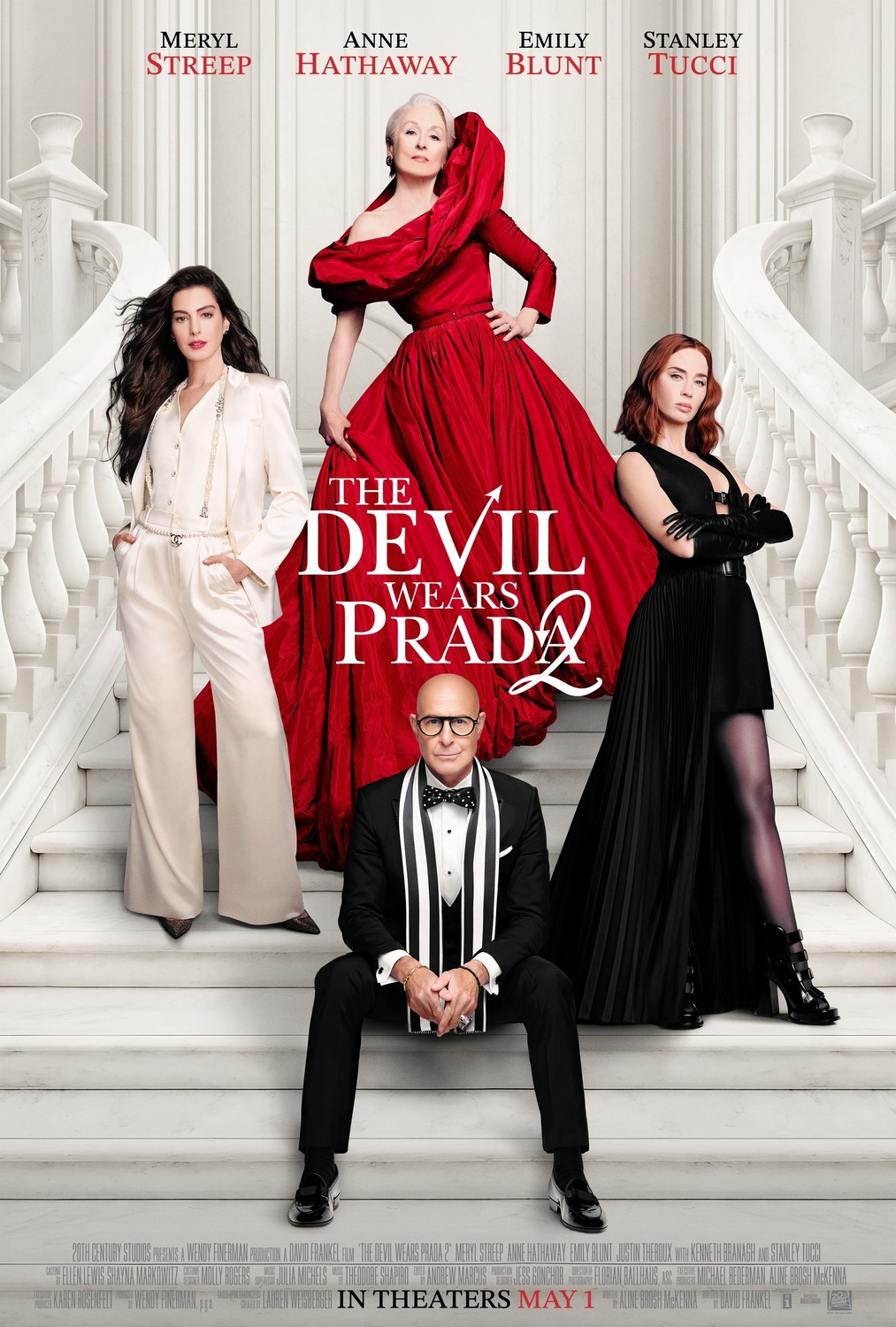
Idealistic young journalism graduate Andy Sachs (irritatingly squeaky-voiced Anne Hathaway) gets a job as 2nd Assistant to Miranda Priestly (Meryl Streep), editor-in-chief of Runway magazine hoping to parlay the position into a job as a crusading social issues reporter at the New Yorker. She soon finds out that fetching scarves from Hermés and slop from Starbucks is not actually journalism though it does approximate it in prestige. The Devil Wears Prada floats comfortably above mediocrity thanks to the exceedingly witty script, nice observations and a performance out of the very top drawer from Streep. It’s worth seeing for her alone.
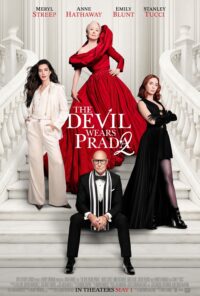
That conclusion is perfectly apt for the sequel as it turns out. Streep turns in another masterclass as Priestly reveals herself to be a much misunderstood tyrant. Turns out that everyone – even the famously single-minded editor of the world’s greatest fashion magazine – has to serve someone.
Twenty years on, both the media industry and the fashion industry have seen some changes. Fashion is even more reliant on branded accessories and retail – Emily Blunt’s Emily has left the magazine to run Dior’s flagship store – and magazines are now secondary to digital influencer content and journalism itself is under threat. Hathaway’s Andy is laid off from her prestigious newspaper feature writing gig at the same time she is accepting an award for it.
The free-spending media world of two decades ago has gone and now the only example of conspicuous luxury consumption is in the world of the tech billionaires who buy and sell properties like Runway magazine on a whim.
More often charming than not, The Devil Wears Prada 2 does carry a serious message along with its laughs at the expense of the fashion world. Media and fashion are both worlds that skew female and when opportunities shrink the impact is felt unequally. And Streep’s lovely final speech, wistfully saying how much she loves her work, could easily be a personal statement, too.
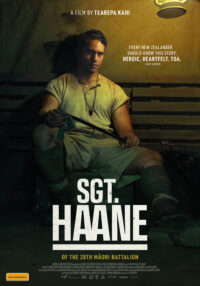
I’m not normally a fan of documentaries relying on dramatic recreations. My sense is – if you don’t have the primary material to work with, make a proper feature film and be done with it1. But I totally understand why Tearepa Kahi has chosen the hybrid model for Sgt. Haane, his salute to Te Arawa WWII hero Haane Manahi who led the successful assault on the Nazi stronghold of Takrouna in Tunisia in April 1943. Manahi was nominated for the Victoria Cross by three senior officers but was downgraded to a Distinguished Conduct Medal on the recommendation of an anonymous British officer.
With no footage of the event – and very little that might supply context for it – and Manahi being modest enough that there isn’t even very much of his life afterwards, dramatic recreations make sense. And because the testimony of his (and other Māori Battalion soldiers) descendants is so crucial to understanding who he was and who he became, you wouldn’t want to leave them out of it either. The present day material also helps contextualise Māori attitudes to military service and the (paradoxically) important relationship to the Crown, making the film more than the sum of its unlikely parts.
The recreations (led by Alex Tarrant as Manahi) work best in the quiet moments, focused on the relationships and moods. I felt that the battle stuff suffered too much from war film clichés to be really moving or even to work all that well as drama. Another section involving a present day Tunisian man recounting his version of the events to his own son reinforces the intergenerational themes but are too obviously staged and the energy drops.
Still, it does Manahi’s story a great service and, hopefully, goes some way towards keeping the deeds of these men alive in our collective memory.

Even though I’m not an official fan of the heavy metal band Iron Maiden, I’ll admit that my mood improves whenever a track of theirs shows up on my shuffle and I am very fond of two documentary films in which they appear. Metal: A Headbanger’s Journey is about the music’s passionate fandom and directors Sam Dunn and Scot McFadyen then got to follow the band around on the 2008 Somewhere Back in Time to make Iron Maiden: Flight 666.
Maiden now have a proper documentary about their history. Burning Ambition uses their prodigious archive2 to tell the story of some lads from starting out in the pubs of East London – furiously resisting the calls form them to embrace Punk – and a meteoric rise to the arenas and stadia of the world. There are a few hiccups along the way but its a fundamentally positive and uplifting story. Even the band members who were kicked out along the journey remain happy for the experience and grateful that they live in a world that still has Iron Maiden in it. And so say we all.
Also reviewed in that October 2006 column: Dwayne (then still “The Rock”) Johnson in Gridiron Gang, “In The Guardian, a big wet tongue kiss to the US Coast Guard, Kevin Costner and Ashton Kutcher battle it out for the title of Captain Smug with Kutcher winning by a length”, “new-fangled” mo-cap animation thriller Renaissance, C.R.A.Z.Y. an early film from the late Jean-Marc Vallée (Dallas Buyers Club, The Young Victoria), and the prescient documentary, Who Killed the Electric Car?
- A good example of a film that supports my argument is Bart Layton’s The Imposter (2012) and he has indeed gone on to make dramatic features. I missed Crime 101 in the cinema but it’s on the catch-up list now that it has arrived on Prime Video. ↩︎
- There’s a long section about a 1984 tour to ‘behind the Iron Curtain’ Poland which seems to be going nowhere until the band goes looking for an after show drink in Poznań, crashes a wedding party and ends up using the wedding band’s instruments to play Deep Purple covers to a bemused congregation. ↩︎