The first three films this week are about men for whom rules do not apply and, because things in the outside world are bleak, I’ll start with the most enjoyable of them.
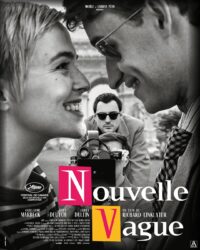
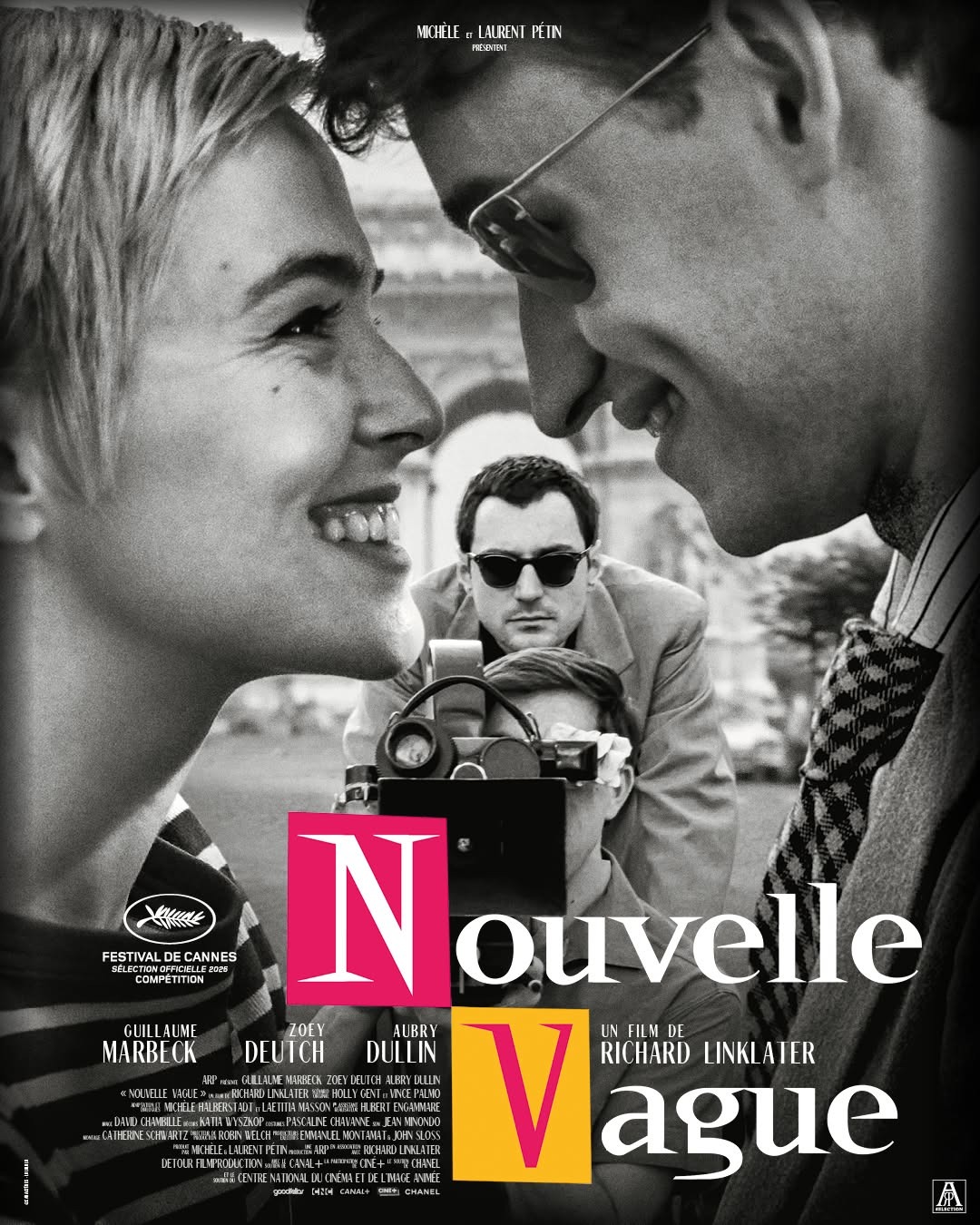
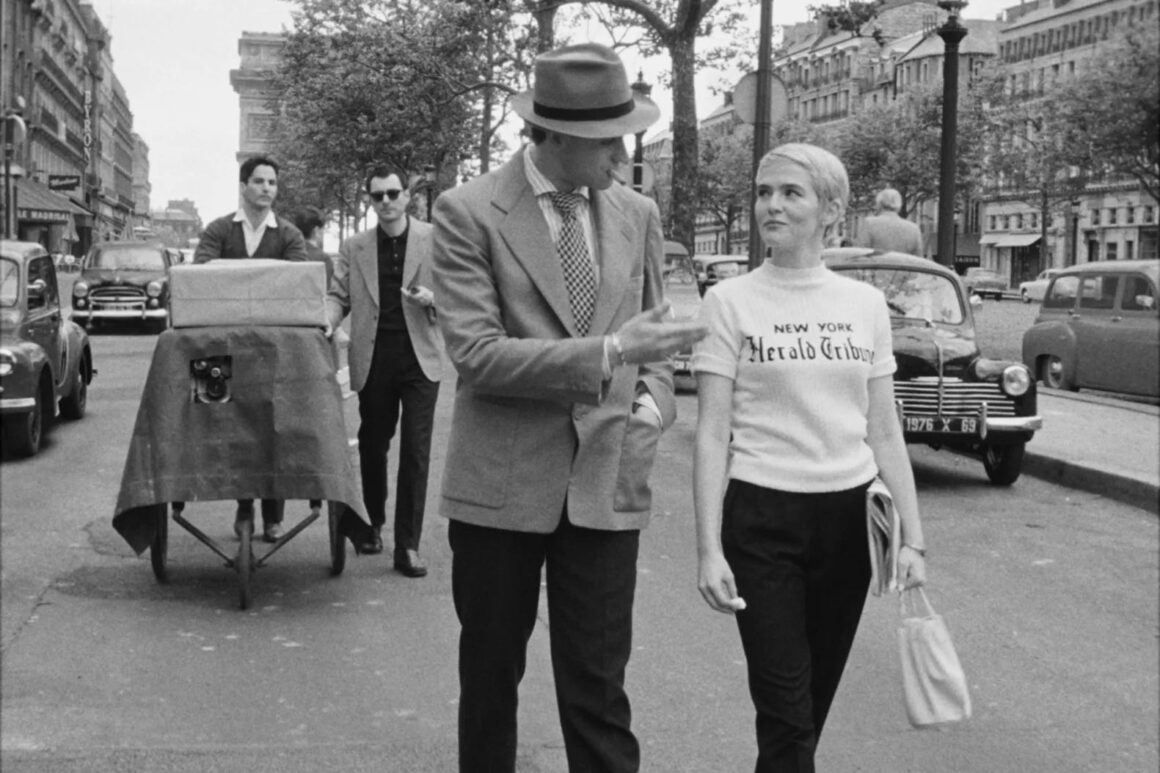
Richard Linklater’s Nouvelle Vague is about the making of Jean-Luc Godard’s groundbreaking Breathless1 (Á bout de soufflé) in 1959 and it’s much more fun than its inspiration. Choosing to ape Godard’s low budget, black and white, 1:.37:1 aesthetic, but avoiding mimicking any specific shots (except in reverse, featuring a mostly bemused crew) it’s as if a 25-year-old Godard is shooting his own behind-the-scenes DVD featurette.
Guillaume Marbeck superbly plays Godard as a legend in his own lunchtime, smirking behind sunglasses, refusing to reveal a masterplan that doesn’t exist, trusting his not-quite fully formed instincts but determined to turn the world of cinema on its head regardless. The scene where he’s forced to make a cameo appearance in his own film, revealing his lack of confidence as an actor, is a gem.
I’ve always thought of Godard in this period as being like Dylan — growing his revolutionary reputation by never explaining himself, or deliberately inventing false trails. Linklater’s film centres Godard but acknowledges the huge community of Cahiers-aligned filmmakers who were also smacking hard up against the boundaries but it was Godard that actually broke them down.

The first act of Kleber Mendonça Filho’s The Secret Agent is so virtuosic that I fount hard to believe it could be maintained and it turns out I was right. But it settles down into something deeper, with more melancholy, slowly building to something profound.
The great Wagner Moura is Armando, a former academic trying to stay one step ahead of the Brazilian military dictatorship in the mid-1970s. Waiting on an urgent fake passport that will get him and his son Fernando out of the country, he works in the Recife office producing identity cards while the corrupt local cops are trying to dispose of a severed leg that might tie them to a political killing.
A loving recreation of a specific Brazilian time and place, The Secret Agent is also a meditation on how easily the connections between generations can be broken, how easily our stories can be forgotten no matter how hard we try and keep them alive.

The Secret Agent would make a great double feature with Marty Supreme if that programme wouldn’t end up taking almost a whole day of your life. They are both fine examples of directors exercising the full flourishing of their skillset and they both feature short scenes about the Holocaust, seemingly unrelated to the film as a whole but actually crucial to understanding their themes.
Until recently, Benny and Josh Safdie were a filmmaking team, most notably on Uncut Gems in 2019. This year they split to make competing high anxiety sports-related films featuring characters screaming at each other in confined spaces. Benny’s The Smashing Machine fell flat for this reviewer but Josh’s Marty Supreme impressed me much more, despite not agreeing with some of his choices.
Timothée Chalamet plays Marty Mauser, a talented table tennis player in 1950s New York, a time when being a talented table tennis player was not the path to wealth and fame that it clearly is now. But it was a popular pastime and Mauser makes some scratch hustling rubes like a skinny and bespectacled Paul Newman2 before heading to London to represent the USA at the British Open.
But while Mauser’s ambition is almost matched by his talent it far exceeds his luck as every plan he makes to get to the top actually sinks him even deeper but his indefatigable spirit is why that close-up of a Marty Supreme table tennis ball at the beginning of the film is so important — “Made in America” it says.
Marty Supreme is a film about desperation. In that brief Holocaust story that we are told, we see how far someone might go to try and keep himself and his fellow concentration camp inmates alive but Marty isn’t fighting for his life, he just thinks he is.
What did I like? The shooting of the table tennis sequences are simply extraordinary. Veteran designer Jack Fisk recreates New York in the early 1950s with a marvellous eye for details of character and class. And Chalamet is terrific, even if his character is borderline intolerable.
But I really could have done without the 80s pop needle drops. Not because they were anachronistic, I have enough imagination to be able to work with those, but because they were so literal. The very first frames of the film are set to Tears for Fears’ Change and I immediately thought, “Oh, I expect that means he’ll change by the end of the picture” and, reader, I was not wrong.

Marty Supreme co-writer and regular Safdie collaborator Ronald Bronstein’s wife Mary Bronstein is the writer and director of If I Had Legs I’d Kick You, a similarly stress-inducing film that’s a superb showcase for the underrated Rose Byrne.
She plays Linda, a therapist and mother going through a series of trials that are testing her to the limit. Her daughter has a feeding disorder3 and has to be fed by a gastric tube. And the bathroom ceiling of her apartment falls in — another connection with Marty Supreme — meaning she has to relocate to a motel. All the while, her absent husband bitches and moans over the telephone.
I really haven’t made my mind up about If I Had Legs I’d Kick You and it will probably need another viewing to really get my head around it — not that I’m in any particular hurry to do that, mind you. If Marty Supreme is abut desperation, If I Had Legs … is about guilt — maternal guilt specifically — and I can appreciate how well it presents Linda’s unravelling but then, near the end, it offers up a new thing for her to feel guilty about, something that’s the foundation for all the other guilts (an ur-guilt, if you will), at least that’s the way it’s presented. But it stacks the deck even further and I’m not even sure that it’s actually anything that she needs to feel terribly guilty about in the first place. But she does, and I have to respect that.
If I still had a podcast, this is the kind of film I would get a special guest on to put me straight. There’s an awful lot to unpack and I don’t think I’m there yet.
Comments
Thanks to reader NF for this comment on my recommendation from last week, The Films of Powell & Pressburger:
This is such a brillaint recommendation. Scorsese’s willingness to celebrate technical mastery alongside storytelling makes his film essays so valueable for anyone trying to understand cinema beyond surface level. I remember watching A Matter of Life and Death in film school and totally missing the VistaVision craftmanship until a professor pointed it out. Powell & Pressburger were dunno, maybe the most underappreciated innovators in British cinema.
- I reviewed Breathless as part of the Sight & Sound 50 Best Films project back in 2023 where I argued that what was once notoriously avant garde is now stylistically familiar. ↩︎
- If you haven’t seen The Hustler (Rossen, 1961) you really, really should. ↩︎
- Not an eating disorder — I’ve learned that while their effects can be similar they are in fact different afflictions. ↩︎