


The two highest profile releases of the week don’t feature in this newsletter and both are examples of a rapidly changing landscape — one I’m finding it hard to keep up with.
Brett Ratner’s ‘documentary’ Melania sucked up all the column inches but despite its notoriety couldn’t find a screen in Wellington to show it. For once, our cinematic poverty works to our advantage. If you’re at all interested in the actual film, the editor-in-chief pointed me at this excellent summary of global reviews. They all watched it so I didn’t have to1.
In arguably more seismic news, the film with the biggest box office results in Australia and New Zealand last weekend was a self-funded horror called Iron Lung by someone the press release calls a ‘YouTube megastar’, Mark “Markiplier” Fischbach. I saw the phrase “self-funded” in the Flicks summary — and having had something of my fill of horror over the last couple of years — gave it a swerve. Clearly, though, 50 million social media followers ( 38 million on YouTube alone) provided enough weight to make it a cultural phenomenon and it means I have to make some adjustments to my thinking.
I don’t spend much time on YouTube and try to remember to not be logged in to any identifiable account when I do. I’ve seen it mostly as a force for social toxicity despite the fact that I use it to learn how to do weird little things all the time. So, while the algorithm has turned a great many ordinary young folk into tragic incel white supremacists, the platform itself is something I finally have to reckon with. Even the BBC recently announced that they would be making original programming especially for YouTube this year.
This was also the week that The Atlantic published an article about how teachers of film studies are having difficulty getting students to actually sit all the way through the films:
Akira Mizuta Lippit, a cinema and media-studies professor at the University of Southern California—home to perhaps the top film program in the country—said that his students remind him of nicotine addicts going through withdrawal during screenings: The longer they go without checking their phone, the more they fidget. Eventually, they give in. He recently screened the 1974 Francis Ford Coppola classic The Conversation. At the outset, he told students that even if they ignored parts of the film, they needed to watch the famously essential and prophetic final scene. Even that request proved too much for some of the class. When the scene played, Lippit noticed that several students were staring at their phones, he told me. “You do have to just pay attention at the very end, and I just can’t get everybody to do that,” he said.
Having said that, the film that prompted all the queues at my local multiplex this weekend was an anniversary screening of The Lord of the Rings so maybe the classics can endure.

Back to this week’s new releases and I enjoyed Ralph Fiennes in the UK historical drama, The Choral. It was an “O.K. Choral”, if you will2. Fiennes plays a choirmaster asked to steer the choral society of a small Yorkshire town, decimated by the loss of male voices to World War One. Fiennes’ character has to battle class as well as wartime prejudice — he spent most of his professional career in Germany where the good music gets made — and the eventual choice of Elgar’s 1900 epic oratorio, The Dream of Gerontius, is a clever one.
Firstly, from a story point of view, it gives the choir something decidedly English to perform — an affection for England despite its faults being a subtext of The Choral — but it also asks modern cinema audiences to consider something outside of the classical big hits repertoire for a change. When the person sitting next to me asked her companion what she thought of the music, the replay was “Not much.” That new-fangled 125-year-old modern music!
Screenwriter Alan Bennett is a national treasure in England and watching The Choral was like enjoying a fine piece of craftsmanship. Not too inspiring but everything in its place and beautifully turned out.

Sam Raimi is also a craftsman but might not fall into the category of national treasure just yet. Send Help is his first engagement with original (i.e.not franchise or pre-existing) material since Drag Me to Hell in 20093.
At one point in Send Help, Rachel McAdams’ Linda Liddle — an unappreciated strategy executive in a big consultancy firm forced to use the knowledge gained from her Survivor fandom to keep herself and her boss alive after a plane crash strands them on a deserted island — says that “monsters are not born, they’re made”, an observation that will become true of her and Dylan O’Brien’s boorish and entitled executive as the film goes on.
Mark Swift and Damian Shannon’s script takes a dim view of human beings and our obsessions about power and control but I’m not sure that’s quite what I want to see at this particular stage in our evolution. I’m more interested in our better natures but I expect I’ll come to appreciate Send Help more when circumstances are less desperate.

As American warships congregate within shooting distance of Iran, I’m reminded of how Iranian cinema has — time and time again — taught me about the incredible complexity of this enormous country and how much I don’t know about ordinary life there. Jafar Panahi’s It Was Just an Accident is another of his films that were made under trying circumstances— no permits and the risk of going back to jail lurking around every corner.
In Accident, a mechanic hears the distinctive sound of a client’s prosthetic leg and is convinced that it belongs to the man who tortured him as a political prisoner. Revenge being a dish best shared, he takes the man captive and gathers a group of other victims to decide what to do. But because none of them ever saw this man’s face, there’s a tiny element of doubt. That doubt prompts an argument — and there are many, many noisy arguments — about what they should do, if anything.
Nothing is simple and everybody’s position is filtered through unimaginable trauma. It’s a moral tale in the way that Send Help is an immoral one. It’s also often very funny, the absurdity of their situation growing with every questionable decision.
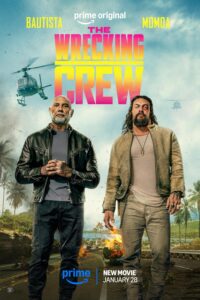
Full marks must be given to producer Jason Momoa for using Jeff Bezos’s money to make a creditable action comedy that also sneaks in an argument for Hawaiian indigenous independence at the same time. The Wrecking Crew is much better than most of the Amazon Saturday night random buddy films I’ve put myself through, largely because that morality (again) is at its core. I find it to be much easier to accept the level of violence in modern movies when the villainous behaviour so clearly deserves it4.
Momoa is joined by Dave Bautista as estranged half-brothers forced to work together to solve the murder of their private investigator father. Bautista is, as we have come to expect, excellent. Considering he’s the same age as your correspondent, he’s looking very good, but I do wonder why actors spend hours in the makeup chair to cover up their existing tattoos only to put new fake ones on top of them. This feels inefficient to me.
Local audiences will be distracted by the extent to which Auckland plays the part of Hawaii — New Zealand kitchens just don’t look anything like American kitchens, have you seen the size of their appliances? — but you have to respect Momoa continuing to believe that Huntly (Idaho in A Minecraft Movie) and Pukekohe (Oklahoma in The Wrecking Crew) are fooling anyone.
- I hate that joke … usually. ↩︎
- If you appreciate this pun then you are welcome here forever. ↩︎
- “Talking of digital artefacts, the new Sam Raimi film Drag Me To Hell is a return to the (mostly) analogue horror form of his early hits like Evil Dead. Ordinary bank worker Allison Lohman is on the verge of getting engaged and getting a promotion until (to further her banking ambitions) she declines a mortgage extension to a gypsy woman with bad teeth. She gets a nasty case of the curses, with only two days to pass it on or give it away before being consigned to Hades forever.
Raimi’s a bit of a one-trick-pony in the shocks department – it does get a bit repetitive – but the film is well plotted and kicks on at a good pace and Lohman is perfectly fine as the Kirsten Dunst you get when you can’t get Kirsten Dunst.” – Capital Times (29 July 2009) ↩︎ - Case in point: The Beekeeper with Jason Statham. The initiating crime in that film is so heinous, I almost offered to jump in and help mete out all that taciturn justice myself. ↩︎
