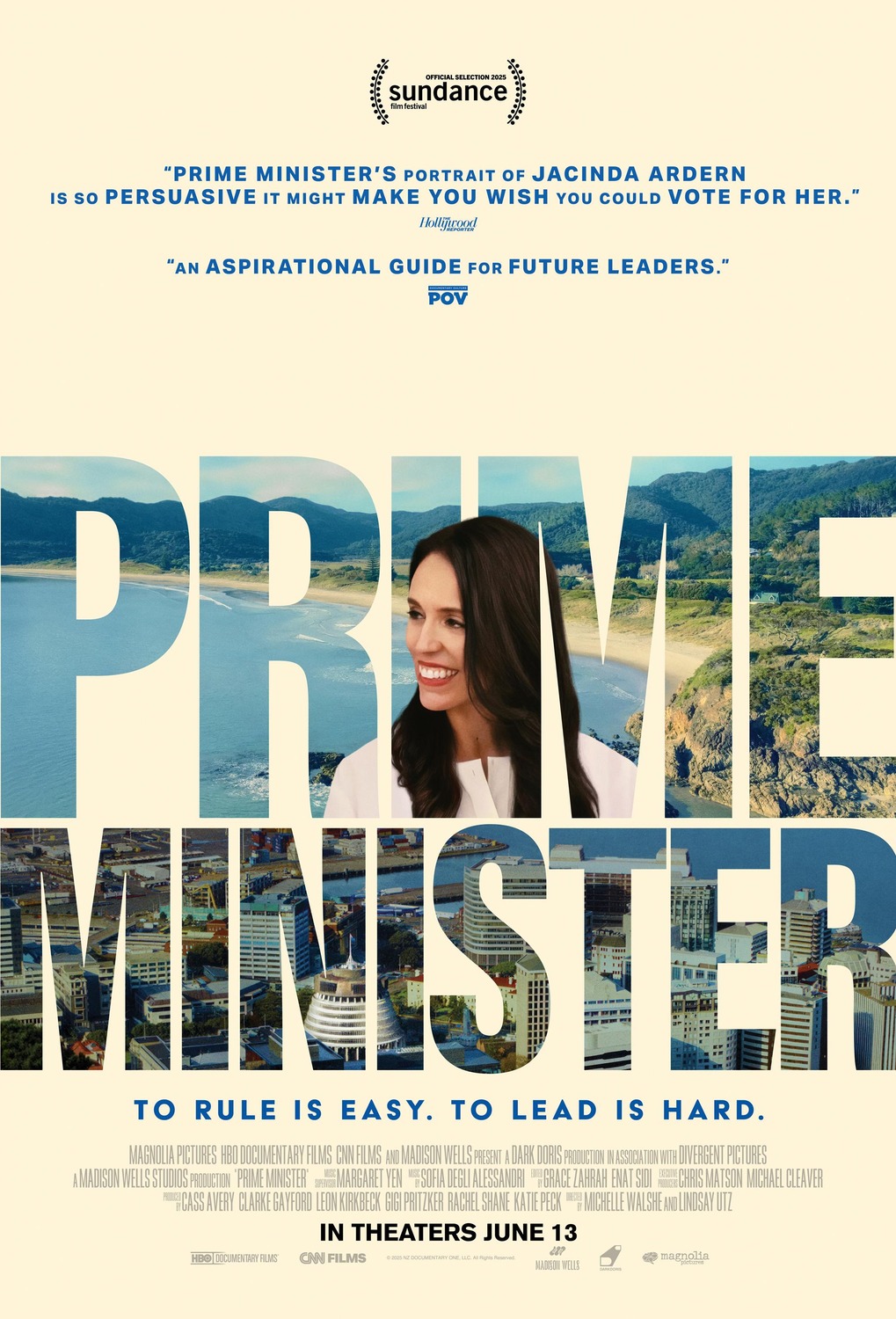

I should let you know from the off that I am utterly unable to be objective about Prime Minister, Lindsay Utz and Michelle Waltz’s documentary about Jacinda Ardern, to the extent that I was in tears through most of it.
That might be a PTSD response to the trauma of the Covid era and its disappointing aftermath, but it’s also a grief response at what we — and the world — have lost in terms of empathetic and human-centred politics. It hit home to me in the first few moments of the film, as Ardern’s daughter Neve hops on to a big yellow American school bus with her mother’s words “I love you” ringing in her — and our — ears, that Ardern wasn’t just hounded from politics, she has been forced out of New Zealand entirely.

The intimacy of the film is astounding — Ardern’s partner Clarke Gayford wielding a home movie camera at convenient and inconvenient times, revealing the bone deep care that Ardern took to her responsibilities, despite the constant wondering whether she was up to it and that gnawing realisation that, despite not wanting the job, at that moment she was the best person for it.
It’s easy to be cynical about politicians’ motives — I read a constant refrain in my social feeds that current PM Christopher Luxon is only in it for the eventual knighthood, which I don’t believe for a moment is true even though I agree with none of his prescriptions for what ails us — and Prime Minister insists that we don’t forget the humans at the centre of the story1. For Ardern, her realness was both her superpower and her kryptonite.
My theory about the power and focus of New Zealand’s elimination approach to the vaccine is that it came from the experiences that Ardern has already had as prime minister.
Firstly — as the film shows in emotional detail — she had already experienced two tragedies in office. 51 people were killed — and 89 injured, many severely — in the Christchurch mosque attacks and 22 died as a result of the Whakaari/White Island eruption and I believe that her starting point when Covid struck was that no one else was going to die, a clarity of purpose that was beyond others who insisted on seeing everything through a cost-benefit lens.
Secondly, she already had experience with a pandemic. In 2017, the cattle bacterium M. Bovis was discovered in New Zealand herds with the potential to cause immense damage to one of this country’s biggest industries. Ardern’s Labour government decided — against the advice of the opposition and many in the public service who said it wouldn’t be possible — that it could be eradicated with drastic controls on the movement of livestock (and the culling of thousands of infected beasts) and they were proved to be correct. That was an inspiration for the “go hard, go early” model of Aotearoa’s Covid response.
One final observation from Prime Minister relates to the loud and aggressive lobby that sprang up against those Covid measures, resulting in Ardern’s resignation and Labour’s loss of the 2023 election. The occupation of Parliament grounds and the eventual riotous eviction comes as a huge shock in the film — and we knew it was coming! For international audiences, less well versed in New Zealand politics, it must come as a thunderbolt.
But there are earlier clues as to the kind of turn that politics is taking. In one scene, when Ardern and other senior government leaders are talking to representatives of the Muslim community following the Christchurch tragedies, Green Party co-leader James Shaw is on the same couch clearly sporting a big black eye, received from a random disaffected member of the public as he was walking to work one morning. It didn’t land as heavily on the rest of us as it obviously did for Shaw, but with hindsight we should have seen where things were heading.

If I’ve learned anything in my 57-plus years on this planet, it’s that if you want something done — and done with diligence, care, respect and situational awareness — you should ask a woman to do it, an observation confirmed by both Prime Minister and Lilith Fair: Building a Mystery, a documentary by Ally Pankiw on Disney+. (It’s also confirmed by Paul Thomas Anderson’s One Battle After Another, but in a very different context.)
The content below was originally paywalled.
Lilith Fair was a festival of women musical artists that criss-crossed North America for three tours in the late nineties. It was a surprise hit and helped galvanise the position of women in the music industry at a time when they were still seen as novelty acts by radio and concert promoters. Led by Canadian singer-songwriter, Sarah McLachlan, Lilith Fair made truckloads of money, developed female talent both on and off stage and proved that big stadium events could still be human-scale.
I realised watching the film that, actually, my musical taste wasn’t fixed in the eighties as I thought it had been. Turns out, as I listened to clips of performances by McLachlan, Lisa Loeb, Tracy Chapman, Emmylou Harris, Shawn Colvin, etc. that that CD-oriented era of great songs, well sung and beautifully recorded, was my happy place and the film took me back there. It’s an excellent story and — once again — brought a tear to the eye. I’ve heard that there’s a documentary about the Indigo Girls and, after seeing their contribution here, that’s one I need to seek out.

One Battle After Another deserves a column all to itself — and will probably get one sooner rather than later — but I still find myself mashing it over in my head several days after we watched it. Anderson is clearly one of the best we have but, as I said to Mark Leishman on the radio last Friday night, there’s no shame in having both major and minor works. (Sign ‘o’ the Times = major, Lovesexy = minor, it’s just natural.) Anderson’s last film, Licorice Pizza, was enjoyable but felt like a minor work. His last film inspired by author Thomas Pynchon, Inherent Vice, felt like a minor work (but I can be persuaded). One Battle After Another is clearly a major work, a statement piece to place alongside There Will Be Blood, The Master and Phantom Thread.
But the ‘how’ of it is what I’m struggling to articulate at the moment. Aspects of it — particularly the tonal shifts — are things I would be critical of in other films but delighted me here. The fact that its context is political — and has a deeply political role to play in our current moment — is important but the film’s actual politics aren’t that easy to put your finger on.
On Friday, I said that it was about how expecting ideological purity from your teammates is a fool’s game because people generally are just too weird to be able to deliver it, and it’s our weirdness that intrigues and delights Anderson more than the specifics of our politics.
Explosives expert “Bob” (Leonardo DiCaprio) is left holding the baby when his partner in life and terrorism, Perfidia Beverly Hills (Teyana Taylor) rats the French 75 revolutionaries out and then escapes from witness protection to continue the struggle elsewhere. Bob escapes into hiding and 16 years later, daughter “Willa” (Chase Infiniti) has become the target of obsessed G‑man Colonel Lockjaw (Sean Penn) while Bob has given in to weed and paranoia.
Bob — and the rest of the 75 — were clearly not up to the task and had to be sacrificed but on the other side of the ideological equation, secretive white supremacists the Christmas Adventurers are starting to have their doubts about their own ambitious recruit, Lockjaw.
But there’s something else going on here — something about allyship and how Bob’s relationship to the revolution will only ever be second-hand. Throughout the film, he’s floundering around — DiCaprio in another great “sweaty fuckup” role — surrounded by people for whom, because of their gender, skin colour, orientation, the resistance is not academic, not something to romanticise while watching The Battle of Algiers on TV.
My favourite character — at the moment — is Benicio De Toro’s Sensei Sergio St. Carlos, calmly wandering around chugging “a few small beers” while rescuing the dozens of migrants he has been sheltering from an immigration raid in which his community is just collateral damage, while the actual target (DiCaprio’s Bob) is oblivious to them all.
Full of thrilling cinematic surprises, One Battle After Another is a fantastic night at the movies, a great reminder of what a ride it can be.
- Former Deputy PM and Finance Minister Grant Robertson officiating at Ardern and Gayford’s wedding, for example. Ardern introducing newborn Neve to current Labour leader of the opposition as “Uncle Chris”, is another. ↩︎