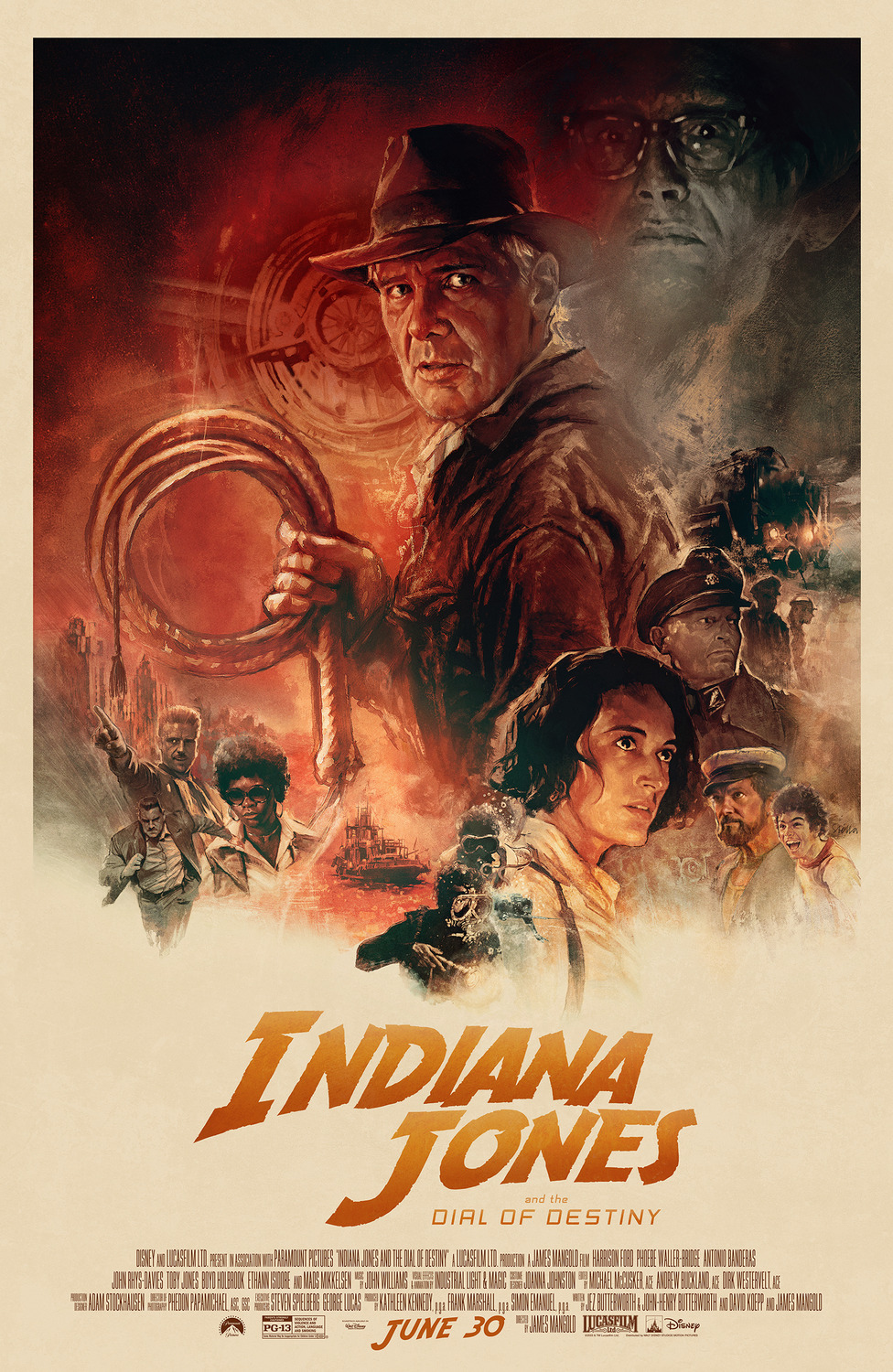
The new Indiana Jones film kicks off with an energetic romp around (and on top of) a moving train. It’s a flashback to a period of Indy’s life that we have heard about in the Kingdom of the Crystal Skull – as an agent for the OSS at the end of World War II attempting to save priceless antiquities from the Nazis – and it serves two purposes. Firstly, to introduce the object that will give the film its title. Secondly, to remind you that you are watching an Indiana Jones picture.
Harrison Ford (and the villain Dr. Voller, played by Mads Mikkelsen) are digitally de-aged for the sequence – more successfully than when the same technology was employed for The Irishman a couple of years ago. I think this is because it is an age-appropriate stuntman doing most of the actual walking, running and climbing rather than the 80-year-old Ford. No matter how many wrinkles the computers could remove there was no disguising the fact that De Niro’s Frank Sheeran in Scorsese’s film had an old man’s posture – bow-legged, back-braced, careful where he put his feet.
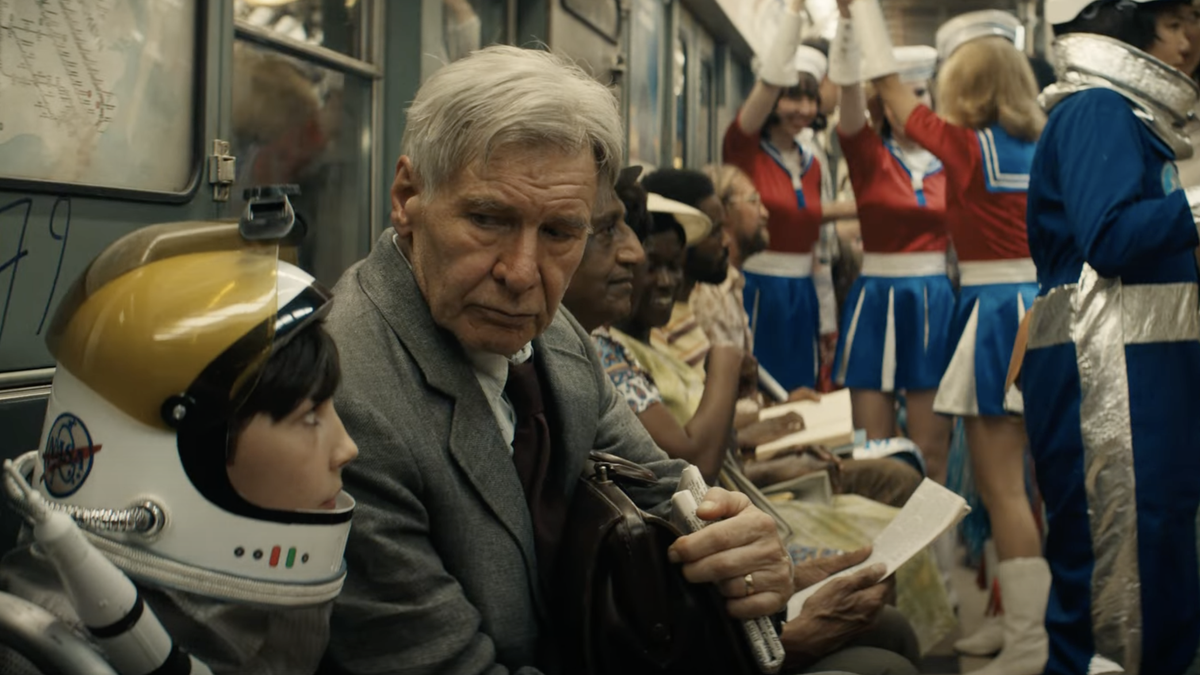
When the extended flashback is over and we return to Indie’s present day the mood becomes much more sombre. Jones is asleep in his underwear in front of the television, in a shabby New York apartment, a whiskey bottle by his side. Today he is officially being retired from his job teaching archaeology at a dead-end Manhattan college and he is being replaced as an American hero by three fresh-faced young astronauts, recently returned from the moon.
And this is where the film gets interesting. Apart from some noisy interruptive and over-extended set-pieces, Indiana Jones and the Dial of Destiny becomes less of an Indiana Jones picture than a Harrison Ford one, an extended depressive meditation on the losses – mostly inevitable but some self-inflicted – of old age.
There are moments in the film that I think are conscious reminders of other Ford performances from his heroic heyday. I think I saw nods to Polanski’s Frantic, certainly to The Fugitive, maybe even Air Force One. I don’t think Ford has been stretched enough as an actor during his monumental career. He and his directors have been able to rely on his screen charisma, his goofy magnetism and – in his youth – his physicality.
But here he looks like an actor who is determined to play the fullness of this character for the first and last time and he manages to be, at times, quite moving. I certainly had a tear in my eye at the end.
The action sequences in Dial of Destiny are at their best when they adhere to the original DNA of the series, those old Saturday morning serials that Lucas and Spielberg were inspired by. Physical rather than digital. Stuntmen rather than avatars.
The films have also always been love letters to British studio craftsmanship, those technicians who were able to turn any hunk of polystyrene into a Himalayan dive bar, an Alpine castle or an underground Hindu temple. I was pleased to see, then, that the interiors for Dial of Destiny were shot at Pinewood in England, where they belong.
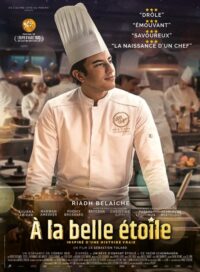
Stallone’s Rocky gets a few shoutouts in Sébastian Tulard’s Sugar and Stars (aka À la belle étoile) which is making a quick return visit to cinemas following the French Film Festival. Ambitious young pastry chef Yazid (Riadh Belaïche) has a best friend who loves that film and who references it often during Yazid’s rise from an unpromising childhood in a foster home to the World Pastry Cup championships.
It helps that Belaïche has a bit of the young Stallone about him in terms of looks and he even seems to dress the part.
The film is an intriguing mix of Loach-ian social realism and European gastro-porn. There’s enough amazing food to make your mouth water but it also does not shy away from Yazid’s difficult early years and his challenge to be accepted by an industry that had no reason to believe in him.
Based on a remarkable true story it appears to hew closely enough to the truth that we end up with bit of a tension deficit during the final competition sequences where the most dramatic thing that happens actually occurs to another team.
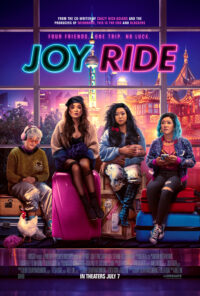
I went into Joy Ride with low-to-no expectations, largely because I hadn’t actually heard of it or the filmmakers (writers Cherry Chevapravatdumrong and Teresa Hsiao, director Adele Lim) before this week. Well, what a pleasant surprise! (I say ‘pleasant’ surprise because it made me laugh and even brought a little bit of depth to proceedings, not because everything that happens in the film is actually ‘pleasant’.)
Audrey (Ashley Park) and Lolo (Sherry Cola) have been best friends since childhood, largely because they were the only Asian kids in the small American town where they lived. Audrey had been adopted from China into a white family and Lolo’s parents run the only Chinese restaurant in town.
Alienated from her language and culture, Audrey is given a chance to reconnect to her roots when the law firm she works for sends her to Beijing to close an important deal. With no Chinese language to speak of, she takes Lolo along to translate and they are joined by two other Asian-American friends: K‑Pop fan Deadeye (Sabrina Wu) and actress Kat (Stephanie Hsu).
Unfamiliar with the drinking culture of Chinese businessmen, Audrey makes rather a mess of things and the only way she can repair the damage is to find her birth mother and present to the high-minded client that she is from an authentic Chinese family.
Even more R‑rated hijinks then ensue on their journey to the hinterland so Audrey can reconnect with her roots. Co-produced by Seth Rogen and Evan Goldberg, Joy Ride closely resembles their 2007 picture Superbad in that somewhere under the sexual innuendo, flatulence, drug misuse and bad language, there is a film – and characters – with real heart. We laughed a lot and were not unmoved at the end.
When I decided to bring this column back from the ashes – involving seeing every film commercially released in Wellington each week – I had forgotten that would involve sitting through garbage like Insidious: The Red Door, the fifth film in a series that started in 2011 and has been absolutely printing money for horror specialist Blumhouse ever since.
Because Patrick Wilson is in this movie (he also directs) I was under the misapprehension that this was actually a Conjuring film and kept wondering when Vera Farmiga was going to turn up. A disappointment on every level, then, The Red Door is a limp extension to a franchise that may once have been scarily novel but now just rehashes tired old jump-scares and takes its plodding time doing it.
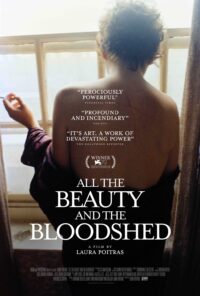
DocPlay has just premiered All the Beauty and the Bloodshed, the Academy Award-nominated documentary from last year about the American photographer Nan Goldin and her campaign (with others) to have the billionaire Sackler family pay for their role in the opioid crisis that has killed hundreds of thousands of American since their introduction of the highly addictive painkiller OxyContin in 1995.
One of the tactics used by campaigners to draw attention to the Sacklers was to focus on their high profile art philanthropy which saw their name on dozens of museum buildings around the world – arts-washing at its most egregious.
It would be ironic if – after all the Sackler’s so-called commitment to these institutions – their greatest actual contribution to the arts were to be inspiring Patrick Radden Keefe’s book about them, “Empire of Pain”, the TV adaptation of that book, Dopesick, and this documentary.
The film isn’t just about opioids and addiction though. Director Laura Poitras artfully weaves three different strands of Goldin’s life together, showing us the parallels between the human neglect that allowed the opioid crisis to rage unanswered for so long, the AIDS crisis of the 80s and 90s that took so many of her friends and colleagues, and the suicide death of her older sister in 1963.
In all these cases, society chose to prioritise making moral judgements on people who were suffering rather than the harm reduction that would save their lives and Goldin (and the film) make the case that that choice represents its own form of immorality. Highly recommended.
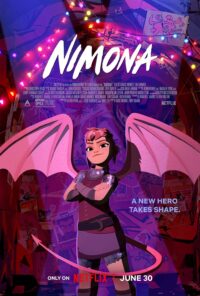
Finally, Netflix has just posted a new animated family film in time for the school holidays and it is enjoyable and thought-provoking in equal measure. Nimona is a story of prejudice and forgiveness, looking forward not back, and questioning orthodoxy. All good stuff for the kids today to be watching!
The film is set in a futuristic city still run on medieval principles. Knights protect the realm from the monsters that everyone is certain lie in wait for them outside that city walls. But the knights ride around on robot horses or in flying cars and the citizenry is just as absorbed by the content on their screens and their deadend jobs as we are here. As long as the monsters never actually show up, what is there to worry about.
For the first time in history a knight qualifies who is not from the nobility. Ballister Boldheart (Riz Ahmed) is also gay and in the closet which will become important later on, but not before he is framed for the murder of the Queen and sent into hiding.
Feisty red-haired teen Nimona discovers him and encourages – nay, bullies – him into going into battle for the truth. She is very persuasive and – voiced by Chloë Grace Moretz – often very funny. She is also a shapeshifter – a superpower that gets her both into and out of trouble.
I’ll leave it to you to discover where the allegorical elements lie but suffice to say there a few and that this film might be a useful prompt for some meaningful discussions between younger members of your family and their parents.